
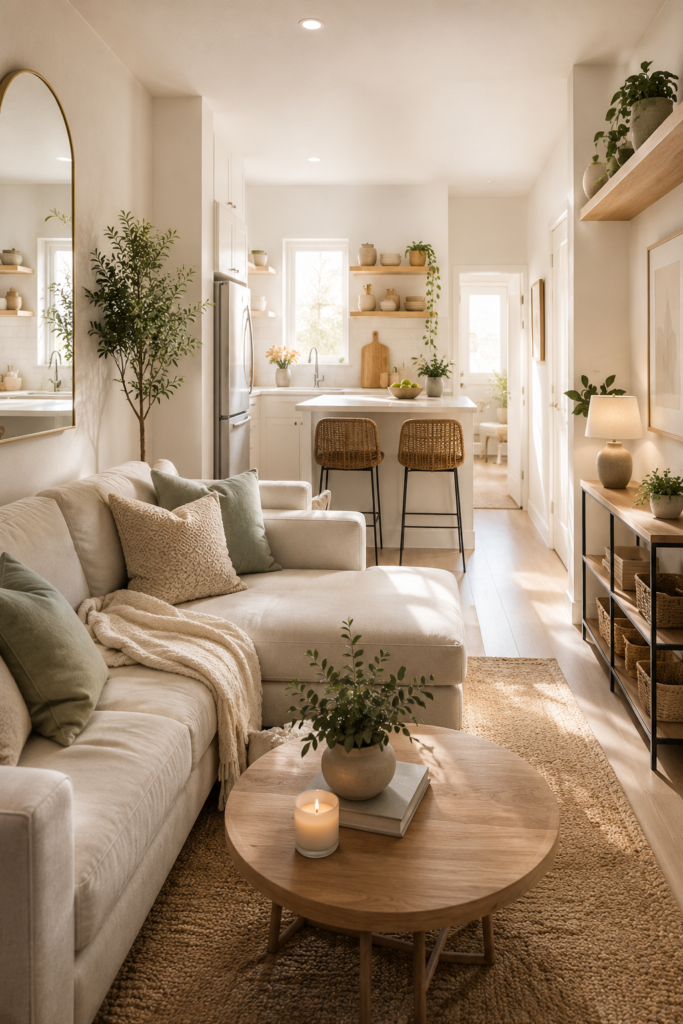
Living in a small home doesn’t mean you have to feel surrounded by clutter.
With the right furniture, layout, lighting, colors, and storage solutions, even a compact apartment or small house can feel noticeably more open and comfortable.
The key is to create the feeling of space, rather than simply trying to fit more things into the room.
That means keeping visual clutter under control, maximizing natural light, choosing furniture carefully, and making every area work harder.
In this guide, we’ll show you 15 practical ways to make a small home feel more spacious, whether you’re decorating a studio apartment, a compact house, or a small rental.
1. Declutter Before You Decorate
The easiest way to make a small home feel larger is to remove unnecessary items.
Clutter takes up physical space and creates visual noise, making rooms feel smaller than they actually are.
Start with:
- Countertops
- Coffee tables
- Open shelves
- Entryways
- Kitchen surfaces
- Bedroom floors
- Closets
Simple decluttering process
- Remove everything from one area.
- Separate items into keep, donate, sell, and discard.
- Return only the things you actually use.
- Give frequently used items a designated home.
- Keep decorative pieces to a minimum.
You don’t need to embrace extreme minimalism.
The goal is simply to make the space feel intentional rather than crowded.
2. Choose Furniture That Fits the Room
Oversized furniture can quickly overwhelm a small space.
Before buying a sofa, bed, dining table, or cabinet, measure both the furniture and the room.
Look for:
- Slim profiles
- Compact dimensions
- Raised legs
- Simple shapes
- Pieces with built-in storage
- Furniture that serves multiple purposes
A large sectional may look comfortable in a showroom but feel completely different in a small living room.
Choose furniture that leaves enough room for comfortable movement.
3. Use Multi-Functional Furniture
In a small home, every piece of furniture should ideally do more than one job.
Consider:
- Ottoman with hidden storage
- Sofa bed
- Storage bench
- Extendable dining table
- Folding desk
- Bed with drawers
- Nesting tables
- Drop-leaf table
Why it works
Multi-functional furniture reduces the number of separate pieces you need.
Instead of adding another cabinet, for example, a storage bench can provide both seating and storage.
This keeps the room functional without making it feel crowded.
4. Choose Light and Neutral Colors
Color has a significant effect on how spacious a room feels.
Light colors can reflect more available light and create a brighter, more open atmosphere.
Consider shades such as:
- White
- Warm white
- Cream
- Beige
- Soft gray
- Light taupe
- Pale blue
You don’t need to make everything white.
A neutral base combined with subtle contrast can create a sophisticated and spacious look.
Pro tip
Use similar colors across connected rooms when possible.
A consistent color palette helps the home feel visually continuous rather than divided into many small spaces.
5. Maximize Natural Light
Natural light can make a small room feel brighter and more open.
Avoid blocking windows with large furniture whenever possible.
Try these ideas:
- Keep window areas clear.
- Use lightweight curtains.
- Choose curtains that allow natural light through.
- Keep windows clean.
- Avoid placing tall storage directly in front of windows.
If privacy allows, let as much natural light into the room as possible.
6. Hang Curtains Higher and Wider
Here’s a simple decorating trick that can make windows appear larger.
Instead of installing the curtain rod directly above the window frame, place it higher and slightly wider when the room and window allow.
Then allow the curtains to extend toward the floor.
This can make the window appear taller and create a stronger sense of vertical space.
Choose curtains in a similar tone to the walls for a seamless look.
7. Use Mirrors Strategically
Mirrors can visually expand a room by reflecting light and creating the impression of additional depth.
You don’t need to cover an entire wall.
Instead, consider placing a mirror:
- Opposite a window
- Near a light source
- Behind a console
- Across from an attractive view
- On a narrow wall
Important
A mirror reflects whatever is in front of it.
Make sure you’re reflecting something attractive or visually useful rather than a cluttered area.
8. Take Advantage of Vertical Space
When floor space is limited, look upward.
Vertical storage can provide valuable capacity without taking up much floor area.
Consider:
- Tall bookcases
- Floating shelves
- Wall-mounted cabinets
- High storage units
- Pegboards
- Wall hooks
The key principle
Use the walls without overcrowding them.
Too many shelves and decorations can create the same visual clutter you’re trying to avoid.
Choose a few useful pieces and leave some wall space open.
9. Keep the Floor as Open as Possible
Visible floor space can make a room feel larger.
Furniture with exposed legs can help create a sense of openness because you can see more of the floor underneath.
For example, choose:
- Sofas with raised legs
- Slim-legged chairs
- Floating cabinets
- Wall-mounted desks
This doesn’t mean every piece needs to float.
Just avoid filling every available section of the floor with furniture.
10. Use a Large Rug Instead of Several Small Rugs
It may seem logical to use a small rug in a small room.
However, multiple small rugs can visually divide the space and make it feel fragmented.
A properly sized rug can help unify the furniture and create a more cohesive room.
Living room tip
Ideally, the rug should be large enough for at least the front legs of your main seating pieces to sit on it.
The exact size depends on your room and furniture arrangement.
11. Create Clear Walking Paths
A small room can feel much larger when movement through it is easy.
Before finalizing your furniture arrangement, identify the natural paths people use to move through the room.
Avoid placing furniture where it blocks:
- Doorways
- Hallways
- Windows
- Cabinet doors
- Frequently used paths
Try this
Arrange your largest furniture pieces first.
Then add smaller pieces only if there is enough room to move comfortably.
Good circulation often matters more than adding another decorative piece.
12. Use Furniture That Matches the Scale of the Room
Scale matters just as much as furniture size.
A small room with several visually heavy pieces can feel cramped even if everything technically fits.
Look for furniture with:
- Slim arms
- Simple silhouettes
- Lighter visual weight
- Proportional dimensions
- Clean lines
Avoid filling a small space with too many bulky pieces.
One comfortable sofa can be better than a sofa, loveseat, two armchairs, and several side tables squeezed together.
13. Keep Surfaces Visually Clean
Open surfaces are valuable in a small home.
Countertops, tables, nightstands, and consoles can quickly become cluttered.
Instead of displaying everything, choose a small number of useful or decorative objects.
Try the three-item rule
Group a few objects together rather than scattering many small items across the surface.
For example:
Console table:
Lamp + decorative object + small tray
Coffee table:
Book + small bowl + plant
Nightstand:
Lamp + book + small personal item
The result feels more intentional and less crowded.
14. Use Smart Storage in Unexpected Places
Small homes often have unused storage opportunities.
Look at:
- Space under the bed
- Space above cabinets
- Back of doors
- Inside cabinet doors
- Corners
- Under stairs
- Space beneath desks
- Narrow gaps between furniture
Practical solutions
Use under-bed containers for seasonal items.
Install hooks behind doors.
Use vertical organizers inside cabinets.
Choose storage baskets that fit awkward corners.
The best storage solution is often the one that uses space you already have.
15. Use Lighting to Create Depth
Good lighting can completely change the perception of a small room.
Instead of relying on one ceiling light, create layers.
Layer 1: Ambient lighting
Provides overall illumination.
Examples include:
- Ceiling fixtures
- Flush mounts
- Recessed lighting
Layer 2: Task lighting
Provides focused illumination.
Examples include:
- Desk lamps
- Reading lamps
- Under-cabinet lights
Layer 3: Accent lighting
Adds atmosphere and visual depth.
Examples include:
- Wall lights
- Small table lamps
- Decorative lighting
Multiple light sources can make a compact room feel more dynamic and inviting.
How to Make a Small Living Room Feel Bigger
The living room is often the most challenging space in a small home.
Start by choosing one main focal point, such as the TV, fireplace, or window.
Then arrange furniture around it.
Try this layout:
- Place the sofa against an appropriate wall.
- Keep a clear path through the room.
- Use a compact coffee table.
- Add one or two lightweight side tables.
- Use a properly sized rug.
- Keep decorations controlled.
- Add layered lighting.
Avoid filling every corner.
Empty space is useful.
How to Make a Small Bedroom Feel Bigger
Bedrooms need to feel relaxing rather than crowded.
Use these strategies:
- Choose a bed proportional to the room.
- Use under-bed storage.
- Install wall-mounted bedside lights.
- Keep nightstands compact.
- Use light-colored bedding.
- Keep the floor clear.
- Use one large mirror.
- Avoid excessive decorations.
Space-saving idea
Wall-mounted bedside lighting can eliminate the need for bulky table lamps and free up valuable nightstand space.
How to Make a Small Kitchen Feel Bigger
Kitchens can become visually crowded very quickly.
Start by clearing unnecessary items from countertops.
Then consider:
- Using vertical storage
- Installing hooks
- Keeping appliances you rarely use in cabinets
- Using drawer organizers
- Choosing light colors
- Adding under-cabinet lighting
- Using one consistent storage system
The coffee maker rule
If you use your coffee maker every morning, leaving it accessible makes sense.
If you use a large appliance once every few weeks, storing it away may free valuable countertop space.
How to Make a Small Bathroom Feel Bigger
Bathrooms benefit greatly from visual simplicity.
Try:
- Light-colored walls
- Large mirrors
- Glass shower doors when practical
- Wall-mounted storage
- Floating shelves
- Minimal countertop items
- Consistent containers
Avoid filling every shelf with products.
Keep daily essentials accessible and store backups elsewhere.
How to Make a Small Entryway Feel Bigger
Entryways are often narrow, so organization is especially important.
Use:
- Wall hooks
- Slim shoe storage
- A narrow console
- A small mirror
- A tray for keys
- Vertical storage
Keep the floor as clear as possible.
A clean entryway immediately makes the entire home feel more organized.
Small Home Layout Mistakes to Avoid
Pushing Everything Against the Walls
While this can sometimes maximize floor space, it isn’t always the best arrangement.
Furniture can sometimes work better when it creates defined zones.
Using Too Many Small Furniture Pieces
Several tiny pieces can create more visual clutter than one appropriately sized piece.
Blocking Windows
Natural light is one of your best tools for making a room feel open.
Overdecorating
Too many accessories compete for attention.
Ignoring Vertical Space
Walls can provide valuable storage without consuming floor area.
Choosing Furniture Without Measuring
Always measure first.
A few minutes with a measuring tape can prevent an expensive mistake.
A Simple Step-by-Step Small Home Makeover
If you want to make your home feel more spacious without renovating, follow this order.
Step 1: Declutter
Remove things you no longer need.
Step 2: Measure
Measure your rooms and major furniture pieces.
Step 3: Improve the layout
Create clear walking paths.
Step 4: Maximize natural light
Clear windows and use lightweight treatments.
Step 5: Add mirrors
Place them where they can reflect light or create depth.
Step 6: Improve storage
Use vertical and hidden storage.
Step 7: Simplify the color palette
Choose a cohesive range of light or neutral colors.
Step 8: Upgrade lighting
Combine ambient, task, and accent lighting.
Step 9: Reduce visual clutter
Keep surfaces and floors relatively clear.
Step 10: Add personality
Finish with a few meaningful decorative pieces.
How to Make a Small Home Feel Spacious on a Budget
You don’t need a major renovation.
Start with inexpensive changes that have a noticeable visual impact.
Free
- Declutter
- Rearrange furniture
- Clear windows
- Remove unnecessary decorations
- Organize surfaces
Low-cost
- Add a mirror
- Install hooks
- Use storage baskets
- Replace heavy curtains
- Add simple lighting
Larger investment
- Multi-functional furniture
- Built-in storage
- Custom cabinetry
- Space-saving furniture
- Improved lighting fixtures
Start with the free changes first.
You may discover that you need fewer new products than you expected.
Frequently Asked Questions
What colors make a small room look bigger?
Light and neutral shades such as warm white, cream, beige, pale gray, and soft blue can help create a brighter and more open feeling.
Do mirrors really make a small room look bigger?
Mirrors can create the impression of additional depth and reflect natural or artificial light. Their effect depends heavily on placement.
Should furniture be against the walls in a small room?
Not necessarily. The best arrangement depends on the room’s shape and circulation. The priority should be comfortable movement and a balanced layout.
Is a large rug better for a small room?
Often, yes. A properly sized rug can visually connect furniture and make the room feel more cohesive than several small rugs.
How can I make a small apartment feel bigger without renovating?
Start by decluttering, improving furniture placement, maximizing natural light, using mirrors, adding vertical storage, and simplifying the color palette.
What type of furniture is best for a small home?
Look for appropriately scaled, multi-functional furniture with built-in storage, slim profiles, or raised legs.
Final Verdict
Learning how to make a small home feel more spacious isn’t about making the room look empty.
It’s about making better use of the space you already have.
Start by removing unnecessary clutter, then improve the layout, maximize natural light, choose furniture carefully, use vertical storage, and create a consistent visual style.
Even small changes can have a significant effect.
The Bottom Line
A spacious-feeling home comes from thoughtful layout, controlled clutter, smart storage, and good lighting—not simply from having more square footage.
When every piece has a purpose and the room has enough visual breathing space, even a small home can feel comfortable, stylish, and surprisingly open.