
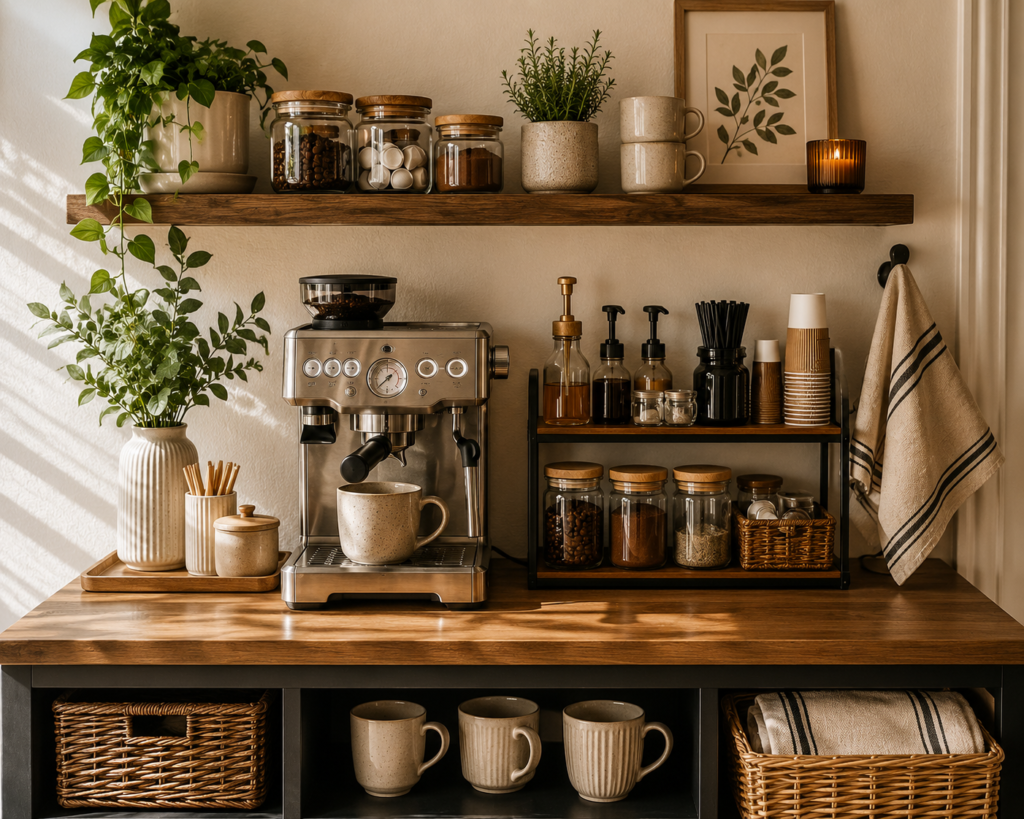
A dedicated coffee station at home can turn your morning routine into something you actually look forward to.
You don’t need a huge kitchen, an expensive coffee machine, or a custom-built cabinet. With the right layout and a few carefully chosen essentials, you can create a coffee corner that is both functional and stylish.
The key is to make everything you need easy to reach while keeping the space organized and visually clean.
Whether you have an entire countertop, a small kitchen corner, a rolling cart, or a compact shelf, this guide will show you how to create a coffee station that works for your space and your daily routine.
What Is a Home Coffee Station?
A coffee station is a dedicated area where you keep your coffee-making equipment, ingredients, and accessories together.
Instead of storing your coffee maker in one place, mugs in another cabinet, and coffee beans somewhere else, a coffee station brings your essentials together.
A well-designed coffee station can include:
- Coffee maker or espresso machine
- Coffee grinder
- Coffee beans or ground coffee
- Mugs
- Kettle
- Filters
- Sugar and sweeteners
- Milk or creamer
- Syrups
- Spoons
- Coffee scales
- Cleaning supplies
The goal isn’t to include everything.
The goal is to create a setup that makes your favorite coffee easy to prepare.
Step 1: Choose the Right Location
The first step is deciding where your coffee station should go.
The best location is usually somewhere that is:
- Easy to access
- Close to an electrical outlet
- Near your water source
- Large enough for your equipment
- Away from excessive heat
- Convenient during your morning routine
Popular locations include:
Kitchen countertop:
The easiest option for most homes.
Kitchen corner:
Perfect for creating a dedicated coffee zone without taking over the entire counter.
Breakfast nook:
A great option if you have unused space near your dining area.
Rolling cart:
Useful for small kitchens or renters who don’t want permanent changes.
Open shelving:
Ideal if you want your coffee station to become part of your kitchen decor.
Cabinet or pantry:
A clever solution when countertop space is limited.
Step 2: Measure Your Available Space
Before buying anything, measure your space.
This simple step can prevent one of the most common coffee station mistakes: buying equipment that doesn’t fit.
Measure:
- Width
- Depth
- Height
- Available wall space
- Distance to electrical outlets
Also consider how you will use the equipment.
For example, an espresso machine may fit on the counter but still be difficult to use if there isn’t enough space above it to remove the water reservoir.
Pro tip
Leave some empty space around your coffee maker.
A coffee station looks more organized when the countertop isn’t completely covered with equipment and accessories.
Step 3: Decide What Type of Coffee You Make
Your coffee station should be built around your actual habits.
Ask yourself:
What do I drink most often?
If you mainly drink drip coffee, you don’t need a complicated espresso setup.
If you enjoy espresso-based drinks, you’ll need space for an espresso machine, grinder, and potentially a milk frother.
If you prefer pour-over coffee, your setup may revolve around a kettle, dripper, server, and coffee scale.
Common setups
Simple coffee station:
Coffee maker + coffee + mugs
Pour-over station:
Dripper + kettle + scale + grinder + beans
Espresso station:
Espresso machine + grinder + tamper + accessories
Coffee and tea station:
Coffee maker + kettle + coffee + tea + mugs
Start with what you use regularly rather than trying to recreate a professional café.
Step 4: Choose Your Coffee Maker
Your coffee maker will usually be the centerpiece of the station.
Choose one based on your preferred brewing method and available space.
Drip coffee maker
Best for making several cups quickly and easily.
Espresso machine
Best for espresso, cappuccinos, lattes, and other café-style drinks.
Single-serve machine
Best for convenience and individual servings.
Pour-over setup
Best for people who enjoy greater control over brewing.
French press
Best for a simple, full-bodied brewing method without a complicated setup.
The most important rule is simple:
Build your coffee station around the coffee you actually drink.
Step 5: Add a Coffee Grinder
If you use whole beans, a grinder is one of the most useful additions to a coffee station.
Grinding coffee immediately before brewing can help preserve aroma and flavor.
A burr grinder is generally preferable to a basic blade grinder because it produces more consistent grounds and gives you better control over grind size.
Choose your grinder based on your brewing method
For espresso, look for a grinder with precise adjustment capabilities.
For drip and pour-over coffee, look for consistent grinding across a useful range of sizes.
For a simple setup, choose a grinder that is easy to use and clean.
Step 6: Create a Dedicated Coffee Storage Area
Keeping your coffee organized is essential.
Avoid leaving multiple bags of beans, open packages, and accessories scattered around the counter.
Good storage options include:
- Airtight coffee containers
- Drawer organizers
- Small baskets
- Canisters
- Wall shelves
- Cabinet organizers
- Pull-out drawers
Keep coffee beans away from excessive heat, moisture, light, and air.
If possible, store them in an airtight container in a cool, dry location.
Step 7: Organize Your Mugs
Mugs are both practical and decorative.
You can store them in several ways.
Inside a cabinet
The simplest and cleanest option.
On open shelving
Useful if you have attractive mugs and want them to contribute to the decor.
Under-cabinet hooks
A clever way to save shelf space.
Mug tree
Useful for keeping frequently used mugs accessible.
Pro tip
Don’t display every mug you own.
Choose a small selection that you actually use. This keeps the station looking intentional rather than cluttered.
Step 8: Create a Coffee Condiment Zone
If you use sugar, sweeteners, syrups, or creamers, give them a dedicated area.
A small tray can work extremely well.
Place frequently used items together, such as:
- Sugar
- Sweeteners
- Stirring spoons
- Cinnamon
- Cocoa powder
- Syrups
- Honey
A tray also makes cleaning easier because you can lift everything at once.
Step 9: Add a Kettle if You Need One
A kettle is especially useful for pour-over coffee, French press, tea, and other manual brewing methods.
If you regularly make pour-over coffee, consider a gooseneck kettle.
Its narrow spout gives you greater control over water flow, which can make manual brewing easier.
For a simple drip setup, however, a kettle may be unnecessary.
Again, choose equipment based on your actual routine.
Step 10: Add a Coffee Scale
A coffee scale is optional, but it can be extremely useful if you want more consistent results.
Instead of measuring coffee and water by eye, you can use precise amounts.
A scale is particularly useful for:
- Pour-over coffee
- French press
- Espresso
- Recipe experimentation
Why it matters
Using the same amount of coffee and water each time makes it easier to reproduce a brew you enjoyed.
If your coffee tastes different every morning, measuring your ingredients can help identify why.
Step 11: Keep Filters and Accessories Organized
Small coffee accessories can quickly create clutter.
Create a dedicated storage area for:
- Paper filters
- Coffee scoops
- Measuring spoons
- Stirring tools
- Espresso baskets
- Cleaning brushes
- Extra accessories
Use small containers or drawer organizers to keep everything together.
The goal is simple:
Every item should have a home.
Step 12: Use Trays to Create Zones
One of the easiest ways to make a coffee station look more organized is to use trays.
Instead of placing individual items randomly on the counter, group them together.
For example:
Brewing tray
Coffee maker + grinder + coffee container
Condiment tray
Sugar + syrups + spoons
Mug area
Mugs + small decorative items
This creates visual separation and makes the entire station feel more intentional.
Step 13: Add Vertical Storage
If your countertop is small, look upward.
Vertical storage can significantly increase your available space without making the counter larger.
Consider:
- Floating shelves
- Wall-mounted mug hooks
- Pegboards
- Small wall cabinets
- Under-cabinet storage
This is especially useful in apartments and small kitchens.
Step 14: Make Your Coffee Station Stylish
A functional coffee station doesn’t have to look purely practical.
You can use simple decor to create a more polished appearance.
Consider adding:
- A small framed print
- A plant
- A decorative tray
- A wooden cutting board
- A small sign
- A ceramic canister
- A neutral-colored container
But avoid adding too many decorative pieces.
A premium-looking coffee station usually relies on simplicity, consistency, and organization.
Step 15: Choose a Consistent Color Palette
A simple color palette can make your coffee station look more cohesive.
For example:
Minimalist
White + black + natural wood
Warm and cozy
Cream + beige + wood tones
Modern
Black + white + stainless steel
Scandinavian-inspired
White + light wood + neutral ceramics
You don’t need to replace all your kitchen accessories.
Simply choose a few pieces that complement your existing kitchen.
Step 16: Keep the Most-Used Items Within Reach
Your coffee station should make your routine easier.
Keep frequently used items closest to the coffee maker.
For example:
Daily use:
Coffee beans, grinder, mugs, coffee maker
Occasional use:
Special syrups, extra filters, decorative accessories
Rarely used:
Backup supplies and seasonal items
This prevents unnecessary movement around the kitchen.
Step 17: Create a Dedicated Cleaning Area
Coffee equipment requires regular maintenance.
Instead of hiding cleaning supplies randomly throughout the kitchen, create a small designated area.
You may need:
- Cleaning brush
- Microfiber cloth
- Espresso machine cleaning products
- Grinder brush
- Descaling solution
Keeping these items together makes routine maintenance easier.
Step 18: Keep Your Coffee Station Clean
A beautiful coffee station can quickly become messy if it isn’t maintained.
Develop a simple daily routine.
After making coffee
- Wipe coffee grounds from the counter.
- Empty used grounds or pods.
- Rinse reusable equipment.
- Wipe spills immediately.
- Return accessories to their storage areas.
Weekly
- Clean the coffee maker components.
- Wash mugs and trays thoroughly.
- Clean the grinder as recommended.
- Remove unnecessary items from the counter.
Periodically
Descale your coffee maker according to the manufacturer’s instructions.
For espresso machines, follow the manufacturer’s recommended cleaning and maintenance schedule.
Step 19: Create a Coffee Station on a Small Budget
You don’t need to spend a lot of money to create a great setup.
Start with what you already own.
Budget-friendly essentials
- Existing coffee maker
- A few favorite mugs
- Airtight coffee container
- Small tray
- Simple storage basket
- Basic spoon or scoop
You can upgrade gradually.
For example:
Phase 1: Coffee maker + mugs
Phase 2: Add storage containers
Phase 3: Add grinder
Phase 4: Add brewing accessories
Phase 5: Add decorative touches
This approach allows you to build the station around your actual needs.
Step 20: Create a Coffee Station Without a Countertop
No countertop space? No problem.
Consider using:
A bar cart
A small rolling cart can hold a coffee maker, mugs, coffee containers, and accessories.
A narrow console table
Useful if you have an unused wall or dining area.
A dedicated cabinet
Keep the coffee equipment inside and open the doors when you’re ready to brew.
A floating shelf
Suitable for lightweight accessories, although heavy coffee equipment should only be placed on shelving designed to support its weight.
Small Coffee Station Ideas
If you’re working with limited space, focus on vertical organization and multipurpose storage.
Idea 1: Corner Coffee Station
Use an unused kitchen corner and add one shelf above the coffee maker.
Idea 2: Coffee Cart
Use a compact rolling cart with two or three levels.
Idea 3: Under-Cabinet Setup
Keep the coffee maker on the counter and store mugs underneath or on hooks.
Idea 4: Pantry Coffee Station
If you have a large pantry with an accessible outlet, dedicate one shelf or section to coffee equipment.
Idea 5: Hidden Coffee Station
Place your equipment inside a cabinet or appliance garage if you prefer a clean countertop.
Common Coffee Station Mistakes
Making the Station Too Crowded
More equipment doesn’t necessarily make better coffee.
Keep only your everyday essentials visible.
Ignoring Electrical Access
Always plan around safe access to electrical outlets and follow your appliance manufacturer’s instructions.
Storing Coffee Near Heat
Avoid placing coffee beans directly next to ovens, stovetops, or other heat sources.
Forgetting About Cleaning
Coffee grounds and spills can quickly make a station look messy.
Buying Accessories Before Equipment
Choose the coffee maker and grinder first. Then buy accessories that support your actual brewing routine.
Prioritizing Appearance Over Function
Your coffee station should look good, but it should also be easy to use.
How to Design a Coffee Station That Looks Expensive
You don’t need expensive furniture or designer accessories.
Instead, focus on a few simple principles.
Keep the countertop clear
Avoid visual clutter.
Use matching containers
Consistent containers create a more polished appearance.
Group items together
Trays help create organized zones.
Add natural materials
Wood and ceramic can make the area feel warmer.
Use one or two decorative pieces
A small plant or framed print can add personality without overwhelming the space.
Hide unnecessary packaging
Transfer coffee accessories and ingredients into attractive containers when practical.
The result should feel intentional rather than over-decorated.
The Ultimate Home Coffee Station Checklist
Before you finish your setup, check that you have:
- A suitable location
- Enough countertop or storage space
- Easy access to electricity
- A coffee maker
- A grinder if you use whole beans
- Coffee storage
- Your favorite mugs
- Filters if required
- A kettle if required
- A coffee scale if needed
- Storage for accessories
- A tray for condiments
- Cleaning supplies
- A simple organization system
- A style that complements your kitchen
You don’t need every item on this list. Select only what fits your brewing method and routine.
Frequently Asked Questions
What should I put in a home coffee station?
Start with your coffee maker, coffee beans or grounds, mugs, and any equipment required for your brewing method. Add storage and accessories based on your daily routine.
Where is the best place for a coffee station?
A kitchen countertop or corner near an electrical outlet is usually convenient. A coffee cart, pantry, or cabinet can work well when counter space is limited.
How do I create a coffee station in a small kitchen?
Use vertical storage, wall-mounted mug hooks, a compact coffee maker, and a small tray. A rolling cart can also provide additional storage without taking permanent counter space.
What coffee accessories do I really need?
The essentials depend on your brewing method. A drip coffee setup may need only a coffee maker, coffee, mugs, and filters. Espresso and pour-over setups typically require additional equipment.
How can I make my coffee station look organized?
Group similar items together, use trays and matching containers, keep frequently used items accessible, and remove unnecessary equipment from the counter.
Can I create a coffee station without a coffee bar cabinet?
Absolutely. A small section of countertop, a rolling cart, floating shelves, or an existing cabinet can all work as a coffee station.
Final Verdict
Creating a coffee station at home is less about buying expensive equipment and more about creating a space that makes your daily routine easier.
Start by choosing the right location and measuring the available space. Then build around your preferred brewing method, whether that’s drip coffee, espresso, pour-over, French press, or something else.
From there, add practical storage for your coffee, mugs, filters, and accessories. Finally, introduce a few carefully chosen decorative touches to give the space personality.
The best coffee station is one that feels effortless to use.
The Bottom Line
Keep your coffee station practical first, organized second, and decorative third. When everything has a place and your favorite brewing essentials are within reach, even a small corner of your kitchen can become a stylish and enjoyable part of your home.