
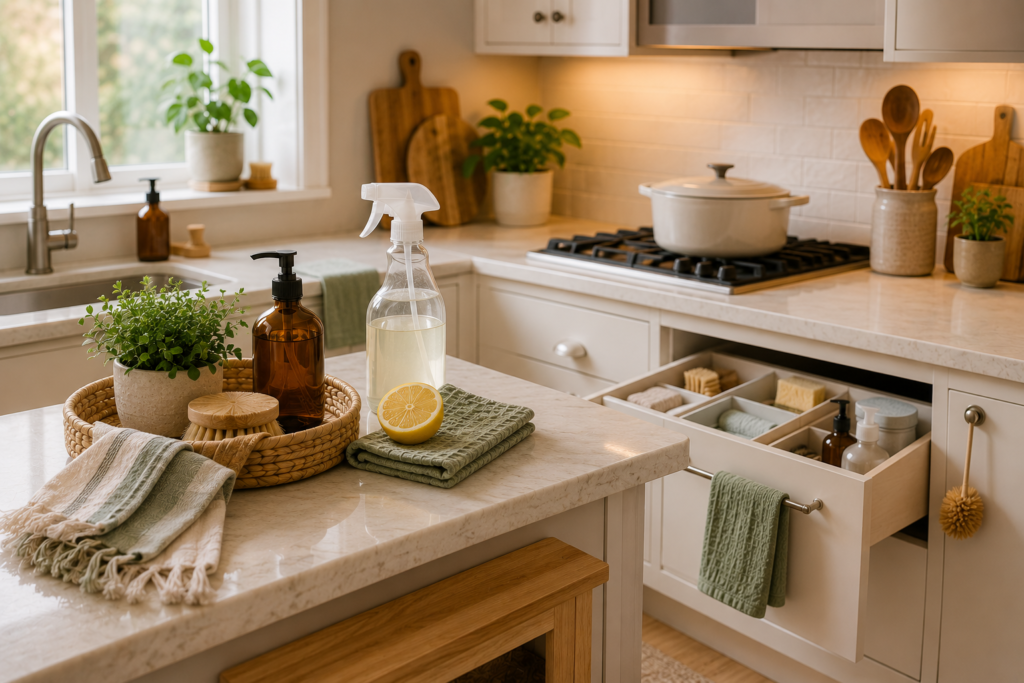
The kitchen is one of the hardest-working rooms in any home.
Between cooking, washing dishes, preparing food, storing groceries, and dealing with everyday spills, it can become messy surprisingly quickly.
But keeping your kitchen clean doesn’t have to mean spending hours scrubbing every day.
The secret is to prevent mess from building up in the first place.
A few simple habits—such as cleaning while you cook, keeping countertops clear, dealing with spills immediately, and giving frequently used items a permanent home—can dramatically reduce the amount of cleaning you need to do.
In this guide, we’ll show you 15 practical ways to keep your kitchen clean with less effort, plus a simple daily and weekly kitchen cleaning routine and the tools that can make the job even easier.
The Secret to an Easier-to-Clean Kitchen
The easiest kitchen to clean is one that doesn’t have unnecessary mess sitting around.
Think of your kitchen maintenance in three stages:
Prevent → Reset → Deep Clean
Prevent
Stop messes from becoming bigger problems.
Reset
Spend a few minutes restoring the kitchen after cooking and meals.
Deep Clean
Handle areas that don’t need daily attention on a weekly or monthly schedule.
This approach is much easier than waiting until the kitchen becomes overwhelming.
15 Ways to Keep Your Kitchen Clean With Less Effort
| # | Habit | Main Benefit |
|---|---|---|
| 1 | Clean while cooking | Reduces post-meal cleanup |
| 2 | Clear countertops | Makes surfaces faster to clean |
| 3 | Deal with spills immediately | Prevents stubborn buildup |
| 4 | Keep cleaning supplies nearby | Saves time |
| 5 | Give everything a home | Reduces clutter |
| 6 | Use your dishwasher strategically | Simplifies dish cleanup |
| 7 | Clean the sink every evening | Creates a fresh starting point |
| 8 | Empty food waste regularly | Prevents odors and mess |
| 9 | Clean as you finish each task | Prevents buildup |
| 10 | Use trays for messy ingredients | Contains spills |
| 11 | Keep appliances maintained | Prevents difficult cleanup |
| 12 | Sweep high-traffic areas regularly | Controls crumbs |
| 13 | Follow a simple weekly routine | Prevents deep buildup |
| 14 | Declutter kitchen gadgets | Reduces cleaning around objects |
| 15 | Finish with a 10-minute reset | Keeps the kitchen under control |
1. Clean While You Cook
One of the easiest ways to reduce kitchen cleaning is to clean during the cooking process.
Instead of finishing your meal and facing a sink full of dishes and a countertop covered with ingredients, use cooking time efficiently.
Try this routine
Step 1: Put ingredients away after using them.
Step 2: Rinse utensils immediately.
Step 3: Load dishwasher-safe items.
Step 4: Wipe spills as soon as they happen.
Step 5: Clean preparation surfaces while food is cooking.
By the time the meal is ready, much of the cleanup may already be finished.
Hot Picks Tip
If something is safe to wash while you’re waiting for water to boil or food to cook, do it then.
Turn waiting time into cleaning time.
2. Keep Your Countertops Clear
A cluttered countertop makes cleaning feel harder than it actually is.
Every appliance, container, utensil, and decoration becomes something you need to move before wiping the surface.
Keep only frequently used items visible
For example:
- Coffee maker
- Toaster
- Knife block
- Frequently used cooking tools
Store appliances you use less often in cabinets or suitable storage areas.
Simple rule
The fewer things on the counter, the faster the counter is to clean.
3. Clean Spills Immediately
A fresh spill is usually easier to deal with than dried-on food.
This is particularly important around:
- Stove tops
- Countertops
- Refrigerator handles
- Cabinet doors
- Floors
The 30-second rule
When you notice a spill:
Stop → Wipe → Continue.
Don’t wait for your regular cleaning session.
This tiny habit can prevent much more difficult scrubbing later.
4. Keep Your Cleaning Supplies Convenient
If you have to walk to another room every time you need a cloth or cleaner, you’re less likely to clean small messes immediately.
Keep commonly used supplies in a convenient location.
A simple kitchen cleaning kit
Consider keeping:
- Microfiber cloths
- Appropriate surface cleaner
- Sponge
- Scrub brush
- Dishwashing supplies
- Gloves
- Paper towels if you use them
Important
Store cleaning chemicals safely away from food, food-preparation areas, and children’s reach.
Always follow product labels.
5. Give Everything in the Kitchen a Home
Kitchen clutter becomes much easier to control when every item has a designated storage location.
Create homes for:
- Pots and pans
- Cooking utensils
- Food containers
- Spices
- Small appliances
- Cleaning supplies
- Kitchen towels
- Reusable bags
The goal
You should be able to answer:
“Where does this belong?”
without thinking.
When items have permanent homes, resetting the kitchen becomes much faster.
6. Use Your Dishwasher Strategically
If you have a dishwasher, use it as part of your cleaning system—not simply as an appliance you run when the sink becomes full.
Try this approach
Step 1: Scrape food from dishes appropriately.
Step 2: Load items as you use them.
Step 3: Avoid creating a pile beside the sink.
Step 4: Run the dishwasher when appropriate.
Step 5: Unload it promptly when the cycle is finished.
This creates a continuous system:
Use → Load → Wash → Unload → Repeat
If you don’t have a dishwasher
Use a similar workflow:
Use → Rinse → Wash → Dry → Put Away
The important part is preventing dishes from accumulating.
7. Clean Your Sink Every Evening
A clean sink can make the entire kitchen feel cleaner.
At the end of the day:
- Remove dishes.
- Rinse away food debris.
- Clean the basin with an appropriate product.
- Rinse thoroughly.
- Wipe the surrounding area.
- Allow it to dry.
You don’t need to deep-clean the sink every night.
The goal is simply to reset it.
8. Empty Food Waste Regularly
Food waste can quickly create odors and attract unwanted pests.
Don’t allow waste to accumulate unnecessarily.
Create a simple routine
Step 1: Dispose of food waste appropriately.
Step 2: Empty the kitchen bin when needed.
Step 3: Replace the liner if you use one.
Step 4: Clean the bin if spills or odors develop.
For homes that compost, follow your local composting guidelines.
9. Clean Each Area When You Finish Using It
Instead of cleaning the entire kitchen at once, reset areas as you finish with them.
Example
After preparing vegetables:
Clear → Wipe → Put tools away
After cooking:
Clean cooking area → Put ingredients away → Deal with dishes
After eating:
Clear table → Load dishes → Wipe surfaces
This keeps the kitchen from reaching the “everything is dirty” stage.
10. Use Trays to Contain Messy Ingredients
Some ingredients naturally create more mess than others.
Oil bottles, spices, coffee supplies, sauces, and baking ingredients can leave residue on surrounding surfaces.
A washable tray can help contain small spills.
Example
Create a coffee station with:
- Coffee machine
- Coffee beans
- Sugar
- Cups
Place suitable items on a tray.
If something spills, you can clean the tray instead of several separate surfaces.
11. Keep Kitchen Appliances Clean
Kitchen appliances can become difficult to clean if residue is allowed to accumulate.
Focus on frequently used appliances such as:
- Microwave
- Air fryer
- Coffee maker
- Blender
- Toaster
- Oven
- Dishwasher
Simple maintenance routine
After use: Deal with obvious spills or food residue.
Weekly: Clean frequently used appliances as appropriate.
Monthly: Inspect less visible areas.
Always follow the manufacturer’s cleaning instructions.
12. Sweep High-Traffic Areas Regularly
Crumbs and food debris naturally end up on kitchen floors.
You don’t necessarily need to deep-clean the entire floor every day.
Instead, focus on areas where debris accumulates.
Quick routine
Step 1: Sweep or vacuum around the cooking area.
Step 2: Check under the dining table.
Step 3: Clean visible spills.
Step 4: Perform a more thorough floor cleaning according to your schedule.
A quick daily or near-daily floor reset can make weekly cleaning much easier.
13. Follow a Simple Weekly Cleaning Routine
Daily maintenance handles small messes.
Weekly cleaning should handle the areas that need more attention.
Weekly kitchen checklist
Clean countertops thoroughly
Clean the sink
Wipe cabinet fronts
Clean the stovetop
Clean the microwave
Sweep or vacuum floors
Mop suitable flooring
Clean appliance surfaces
Empty and clean the trash bin if needed
Check the refrigerator for expired food
Don’t try to deep-clean everything at once.
Work systematically.
14. Declutter Kitchen Gadgets
Kitchen gadgets can make cooking easier—but too many can make cleaning harder.
If your countertop and cabinets are filled with appliances you rarely use, your kitchen becomes harder to organize.
Try the following
Step 1: Remove gadgets you rarely use.
Step 2: Group similar tools together.
Step 3: Keep daily-use items accessible.
Step 4: Store occasional-use appliances away.
Step 5: Consider donating or selling items you no longer need.
Ask yourself
“Would I buy this again today?”
If not, it may be taking up valuable space.
15. Finish With a 10-Minute Kitchen Reset
The final reset is what keeps everything from building up.
At the end of the day, set a timer for 10 minutes.
Minute 1–2
Clear countertops.
Minute 3–4
Load or wash dishes.
Minute 5
Clean the sink.
Minute 6
Wipe the stovetop.
Minute 7
Put ingredients away.
Minute 8
Clear the dining area.
Minute 9
Sweep or vacuum obvious debris.
Minute 10
Return everything to its designated home.
When the timer ends, stop.
The goal is consistency—not perfection.
A Simple Daily Kitchen Cleaning Routine
If you want a routine that’s easy to remember, use this:
Morning
Empty dishwasher if necessary
Put away clean dishes
Wipe breakfast preparation areas
During the Day
Clean spills immediately
Put ingredients away
Wash or load dishes
Clean as you cook
Evening
Clear countertops
Finish dishes
Clean the sink
Wipe the stovetop
Sweep visible debris
Empty food waste if necessary
This routine can take only a few minutes when followed consistently.
A Weekly Kitchen Cleaning Schedule
Monday
Clean countertops and sink.
Tuesday
Clean appliances you use frequently.
Wednesday
Clean cabinet handles and fronts.
Thursday
Clean the stovetop and backsplash.
Friday
Check the refrigerator and discard expired food.
Saturday
Vacuum or sweep and mop the floor.
Sunday
Do a quick kitchen reset and restock supplies.
You can also complete everything in one weekly session if that works better for your schedule.
Monthly Kitchen Cleaning Checklist
Once a month, consider cleaning areas that don’t need weekly attention.
Monthly tasks
Clean refrigerator shelves and drawers
Wipe cabinet interiors where necessary
Clean the oven if needed
Clean under small appliances
Check pantry expiration dates
Clean range hood surfaces and filters according to instructions
Declutter kitchen drawers
Clean the trash bin thoroughly
Check cleaning supplies
How to Make Kitchen Cleaning Faster
The goal isn’t to clean faster by rushing.
It’s to reduce the amount of cleaning you have to do.
Keep these five principles in mind:
1. Prevent mess
Use trays, lids, and careful preparation when appropriate.
2. Clean immediately
Don’t allow spills to dry.
3. Keep surfaces clear
Less clutter means less work.
4. Clean as you cook
Use waiting time efficiently.
5. Reset every evening
Start the next day with a clean kitchen.
Kitchen Cleaning Tools Worth Considering
You don’t need every cleaning gadget available.
Choose tools that solve problems you regularly encounter.
Microfiber Cloths
Best for: Countertops, appliances, and general wiping.
Dish Brush
Best for: Cleaning dishes and suitable surfaces.
Cleaning Caddy
Best for: Keeping frequently used cleaning supplies together.
Handheld Vacuum
Best for: Quick crumb and debris cleanup.
Cordless Vacuum
Best for: Fast floor cleaning without dealing with a power cord.
Electric Spin Scrubber
Best for: Reducing manual scrubbing on suitable surfaces.
Dishwasher
Best for: Automating a large part of daily dish cleanup.
The best tool is the one that makes a repetitive task easier or faster without creating another maintenance problem.
Common Kitchen Cleaning Mistakes
Letting dishes pile up
A full sink makes the entire kitchen feel messy.
Leaving appliances on the counter
Unused appliances take up valuable workspace and make surfaces harder to clean.
Ignoring cabinet handles
Handles can collect fingerprints and food residue.
Waiting to clean spills
Dried food and grease are usually harder to remove.
Using the wrong cleaner
Always choose products suitable for the specific surface.
Forgetting hidden areas
Under appliances, around the stove, and inside drawers can accumulate debris.
Trying to deep-clean every day
Daily cleaning should focus on maintenance. Save deeper tasks for your weekly or monthly routine.
Frequently Asked Questions
How can I keep my kitchen clean all the time?
You don’t need to clean constantly. Clean as you cook, deal with spills immediately, keep countertops clear, and finish each day with a short kitchen reset.
What should I clean in my kitchen every day?
Focus on dishes, countertops, the sink, cooking surfaces, spills, and visible floor debris.
How often should I deep-clean my kitchen?
A more thorough kitchen cleaning can be done weekly, while less frequently used areas and appliances can be handled monthly or as needed.
How do I keep my kitchen clean while cooking?
Put ingredients away after using them, rinse utensils, load the dishwasher, wipe spills immediately, and clean preparation areas while food cooks.
How do I keep my kitchen counters clutter-free?
Keep only frequently used items visible and store occasional-use appliances and tools in designated cabinets or storage areas.
What is the fastest way to clean a kitchen?
Clear clutter first, load or wash dishes, wipe countertops and cooking surfaces, clean the sink, and finish with the floor.
Are kitchen cleaning gadgets worth buying?
They can be useful when they solve a specific recurring problem. Focus on tools that reduce repetitive work rather than buying gadgets simply because they are popular.
Final Verdict
Keeping your kitchen clean with less effort isn’t about cleaning more.
It’s about creating a kitchen that is easier to clean.
Keep countertops clear. Give everything a home. Clean while you cook. Deal with spills immediately. Use your dishwasher strategically. And finish the day with a quick reset.
These habits may only save a few minutes at a time, but those minutes add up.
More importantly, they prevent small messes from becoming large cleaning projects.
If you want to make kitchen cleaning even easier, focus on the tools that remove repetitive work—such as a good cordless vacuum, dishwasher, microfiber cloths, or other practical cleaning gadgets.
The goal isn’t a spotless kitchen every minute of the day.
It’s a kitchen that stays manageable without taking over your time.