
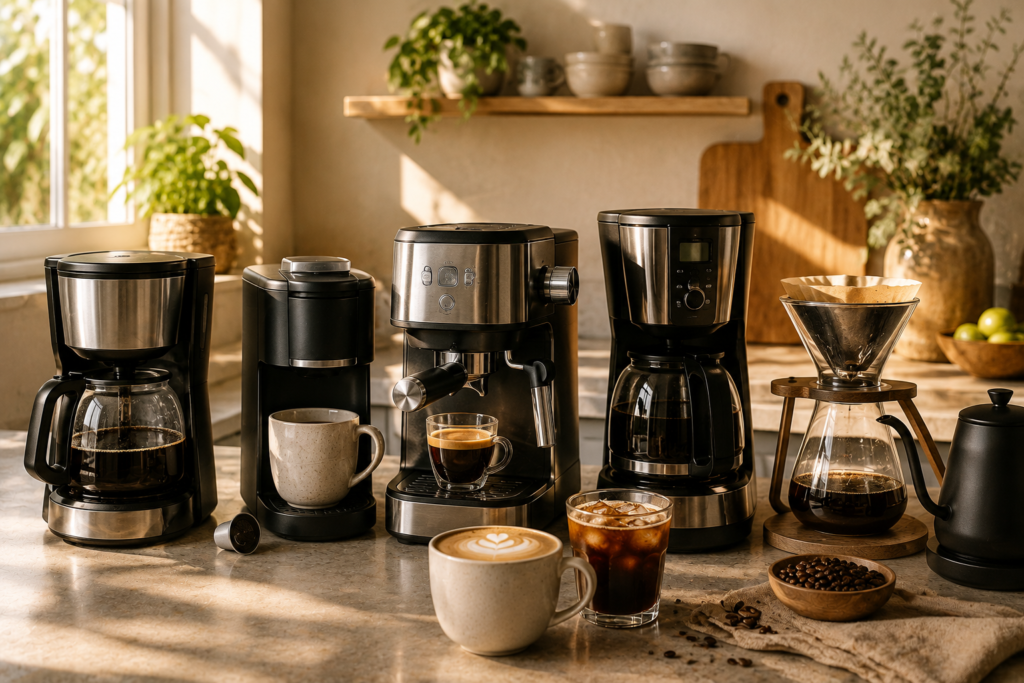
Choosing a coffee maker can be surprisingly difficult. Walk into any appliance store or browse online, and you’ll find everything from simple drip machines to programmable brewers, single-serve systems, espresso machines, and premium specialty coffee makers.
The best coffee maker isn’t necessarily the most expensive one. It’s the one that matches how you drink coffee, how much you make, how much control you want, and how much maintenance you’re willing to handle.
Before buying, consider the brewing method, capacity, controls, temperature, speed, carafe design, cleaning requirements, grinder options, and overall value.
This guide walks you through the most important factors step by step so you can choose a coffee maker with confidence.
Quick Checklist: What to Look for in a Coffee Maker
Before comparing individual models, look for these key features:
- The right brewing method
- Suitable capacity
- Consistent brewing temperature
- Easy-to-use controls
- Programmable settings if needed
- Good carafe design
- Automatic shutoff
- Easy cleaning and maintenance
- Reusable or accessible filters
- Appropriate counter space
- Durable construction
- Useful warranty
- Features you will actually use
- A price that fits your budget
The most important factor is how well the machine fits your daily routine.
Step 1: Choose the Right Type of Coffee Maker
The first decision is the brewing method.
Different coffee makers are designed for different styles of coffee, so start by deciding what you actually enjoy drinking.
Drip Coffee Makers
Drip coffee makers are among the most practical choices for everyday coffee.
They heat water and distribute it over ground coffee before the brewed coffee collects in a carafe.
Best for:
- Everyday black coffee
- Families
- Making multiple cups
- Simple brewing
- Programmable morning coffee
Advantages:
- Easy to use
- Large capacity
- Convenient
- Generally affordable
- Good for regular coffee drinkers
If you want a straightforward machine that can make several cups at once, a drip coffee maker is often the best place to start.
Single-Serve Coffee Makers
Single-serve machines are designed to prepare one cup at a time.
Depending on the system, they may use coffee pods, capsules, or ground coffee.
Best for:
- One or two coffee drinkers
- Convenience
- Different coffee flavors
- Quick preparation
- Small kitchens
Consider:
The convenience can come with higher per-cup costs and additional waste if the system relies heavily on disposable pods.
If you value speed and simplicity above everything else, however, single-serve brewing can be extremely convenient.
Espresso Machines
Espresso machines are designed to produce concentrated espresso by forcing hot water through finely ground coffee.
They are ideal if you enjoy:
- Espresso
- Lattes
- Cappuccinos
- Americanos
- Macchiatos
- Other espresso-based drinks
Important consideration
Espresso machines usually require more involvement than standard drip coffee makers.
You may need to grind beans, measure coffee, tamp the grounds, clean the machine, and adjust your recipe.
If you want café-style drinks at home and enjoy the process, an espresso machine can be an excellent investment.
Pour-Over Coffee Makers
Pour-over brewing gives you greater control over the brewing process.
You manually pour hot water over coffee grounds, allowing you to control variables such as water flow and brewing time.
Best for:
- Coffee enthusiasts
- Specialty coffee
- Experimenting with recipes
- Greater brewing control
The trade-off is that pour-over brewing requires more attention than pressing a button on an automatic coffee maker.
Step 2: Choose the Right Capacity
Capacity is easy to overlook, but it can make a major difference in daily convenience.
Ask yourself:
How much coffee do I normally make at one time?
Small capacity
A compact coffee maker may be ideal for one person or a small household.
Medium capacity
A medium-size machine can be a good compromise for couples or households with moderate coffee consumption.
Large capacity
A larger carafe makes sense if several people drink coffee throughout the morning.
However, bigger isn’t always better.
A large coffee maker takes more counter space and may encourage you to make more coffee than you actually need.
Choose capacity based on your normal routine rather than the maximum number of cups advertised on the box.
Step 3: Understand Coffee Maker “Cup” Measurements
One important detail is that a coffee maker’s “cup” does not always mean a standard 8-ounce cup.
Manufacturers may use smaller serving measurements when describing capacity.
For example, a machine advertised as making 12 cups may hold considerably less than twelve traditional 8-ounce servings.
Buying tip
Look for the actual water reservoir or carafe capacity, preferably in ounces or liters, rather than relying only on the advertised cup count.
This gives you a more accurate idea of how much coffee the machine can actually make.
Step 4: Look for Good Brewing Temperature
Water temperature plays an important role in coffee extraction.
If the water is not hot enough, the coffee may taste weak or under-extracted.
If the brewing process becomes excessively hot, undesirable flavors can develop.
For automatic coffee makers, look for models that provide consistent brewing temperature rather than focusing only on a specific advertised temperature number.
Consistency matters because you want your coffee to taste similar from one brew to the next.
Step 5: Consider Programmable Features
Programmable features can make a coffee maker much more convenient.
Depending on the model, you may be able to set:
- A brewing start time
- Brew strength
- Serving size
- Keep-warm duration
- Auto shutoff
- Cleaning reminders
Is programming worth it?
If you like waking up to freshly brewed coffee, definitely.
If you usually make coffee manually whenever you want it, programmable features may not be important enough to justify paying extra.
Think about your routine before paying for additional technology.
Step 6: Decide Whether You Want a Built-In Grinder
Some coffee makers include a built-in burr grinder.
This allows the machine to grind whole beans immediately before brewing.
Benefits
- Freshly ground coffee
- Fewer separate appliances
- Convenient workflow
- Less equipment on your countertop
Drawbacks
- More expensive
- More components to clean
- Grinder performance varies between models
- Repairs can be more complicated
If freshness is important but convenience matters even more, a coffee maker with a built-in grinder can be appealing.
However, a separate quality grinder often gives you greater control and flexibility.
Step 7: Check the Brew Strength Controls
Some coffee makers offer adjustable brew strength.
This can be useful if people in your household prefer different coffee styles.
For example, a stronger setting may slow or modify the brewing process to increase extraction.
But don’t assume that a “strong” button automatically means better coffee.
A good coffee maker should produce balanced coffee under its standard brewing conditions. Strength settings are useful when you want to customize the result.
Step 8: Consider the Carafe
The carafe is one of those features you may not think about until you use the machine every day.
Look for:
- A comfortable handle
- A drip-resistant spout
- A secure lid
- Easy pouring
- Easy cleaning
- Good heat retention
Glass Carafe
Glass carafes allow you to see how much coffee remains.
They are often paired with a hot plate.
Advantages:
- Easy to see coffee level
- Simple design
- No concern about vacuum-seal performance
Disadvantages:
- Coffee can lose quality if left on a hot plate for too long
- Glass can break
Thermal Carafe
Thermal carafes are designed to retain heat without relying on a hot plate.
Advantages:
- Better heat retention
- No hot plate required
- Can help avoid prolonged heating
Disadvantages:
- More difficult to see the coffee level
- Can be more expensive
- Some designs are harder to clean
If you regularly brew coffee and drink it over several hours, a thermal carafe may be worth considering.
Step 9: Check How Easy It Is to Clean
A coffee maker that produces excellent coffee but is difficult to clean can quickly become frustrating.
Before buying, check whether the following components are removable:
- Water reservoir
- Filter basket
- Carafe lid
- Drip tray
- Grinder components, if included
Also check the manufacturer’s cleaning instructions.
Look for:
Removable parts: Easier to wash.
Dishwasher-safe components: Convenient when available.
Descaling programs: Useful for reducing mineral buildup.
Cleaning alerts: Helpful if you tend to forget maintenance.
Step 10: Consider Water Filtration
Some coffee makers include water filters designed to reduce certain impurities and improve water quality.
Water quality matters because coffee is primarily water.
If your tap water has noticeable mineral content or an unpleasant taste, a water filtration system can make a noticeable difference.
However, filters require regular replacement.
Before buying a machine with a proprietary filter, check the cost and availability of replacement filters.
Step 11: Look for Adjustable Brew Settings
More control can be useful, especially for coffee enthusiasts.
Depending on the machine, you may find settings for:
- Brew strength
- Serving size
- Temperature
- Pre-infusion
- Brewing time
- Grind size on integrated grinders
But more settings don’t automatically mean better coffee.
The best controls are the ones you will actually use.
For beginners, a simple machine that consistently makes good coffee may be better than a complicated model filled with features you never touch.
Step 12: Consider Speed
How quickly do you want your coffee?
If you’re always rushing in the morning, brewing speed may be an important factor.
Single-serve machines can be particularly convenient when you only need one cup.
Drip coffee makers are better suited to brewing a larger batch.
Espresso machines can produce drinks quickly once they’re fully heated and prepared, but the preparation process can take longer.
Choose based on your total routine, not just the extraction time.
Step 13: Think About Noise
Noise isn’t usually the first specification people consider, but it can matter.
This is especially true if:
- You wake up before everyone else
- Your kitchen is near bedrooms
- You use a grinder early in the morning
- You live in a small apartment
Coffee grinders can be noticeably louder than brewing itself.
If quiet operation matters to you, look for reviews that specifically mention noise levels.
Step 14: Check the Countertop Footprint
Before buying a coffee maker, measure your available counter space.
Don’t forget to account for:
- Width
- Depth
- Height
- Space above the machine
- Access to the water reservoir
- Space needed to remove the carafe
- Space needed to open the filter basket
A machine may technically fit under your cabinets but still be inconvenient if you cannot easily fill the water reservoir.
Step 15: Look at Ease of Use
A premium coffee maker doesn’t need to be complicated.
Consider whether you can easily:
- Fill the water reservoir
- Add coffee
- Start brewing
- Adjust settings
- Remove the filter
- Pour the coffee
- Clean the machine
A clear display and intuitive controls can make a bigger difference than a long list of advanced features.
Step 16: Consider the Warranty and Long-Term Reliability
A coffee maker is an appliance you’ll likely use frequently.
Before buying, check:
- Warranty length
- Warranty coverage
- Availability of replacement parts
- Availability of accessories
- Customer support
- General reputation for reliability
A slightly more expensive machine may offer better value if it is designed to last longer and is easier to repair or maintain.
Step 17: Set a Realistic Budget
Coffee makers can range from inexpensive basic machines to premium equipment costing significantly more.
Instead of asking:
“What is the best coffee maker?”
Ask:
“What is the best coffee maker for my needs and budget?”
Budget-friendly
Focus on:
- Reliable brewing
- Easy cleaning
- Appropriate capacity
- Simple controls
Mid-range
You can look for:
- Better temperature consistency
- Programmability
- Brew-strength controls
- Better carafe design
- Improved construction
Premium
You may consider:
- Advanced brewing controls
- Built-in grinders
- Specialty coffee capabilities
- Premium materials
- Automated cleaning
- Greater customization
Don’t pay for features you won’t use.
Step 18: Read Reviews the Right Way
Online reviews can be extremely helpful, but don’t focus only on the overall star rating.
Look for repeated comments about:
- Coffee quality
- Durability
- Cleaning
- Noise
- Leaking
- Carafe design
- Water reservoir
- Ease of use
- Customer service
One negative review doesn’t necessarily indicate a bad product.
Repeated complaints across many reviews are much more useful.
Features Worth Paying More For
Some features can genuinely improve your daily coffee experience.
Worth considering:
- Consistent brewing temperature
- Quality burr grinder
- Easy-to-clean components
- Thermal carafe
- Programmable brewing
- Adjustable brew strength
- Durable construction
- Good warranty
- Accessible replacement parts
Features you may not need:
- Excessively complicated touchscreens
- Too many preset programs
- Decorative displays
- Smartphone connectivity you won’t use
- Features that don’t improve the actual brewing process
The goal is useful functionality, not the longest feature list.
Common Coffee Maker Buying Mistakes
Buying Based Only on Price
Expensive doesn’t always mean better.
Choosing the Wrong Capacity
A large machine can be unnecessary for one coffee drinker.
Ignoring Cleaning
A machine that is difficult to maintain may become frustrating over time.
Focusing Too Much on Smart Features
Connectivity is convenient, but it doesn’t automatically make better coffee.
Forgetting Counter Space
Always measure your kitchen before buying.
Ignoring Replacement Costs
Filters, cleaning products, water filters, and other accessories can add to the long-term cost.
Buying for Everyone Except Yourself
Consider what you actually drink.
If you mainly drink espresso-based beverages, a basic drip machine may not satisfy you.
A Simple Coffee Maker Buying Checklist
Before clicking “Buy,” ask yourself these questions:
- What type of coffee do I drink most?
- How many people will use the machine?
- How much coffee do I normally make?
- Do I want programmable brewing?
- Do I want a built-in grinder?
- Do I prefer a glass or thermal carafe?
- How much counter space do I have?
- Is the machine easy to clean?
- Are replacement filters easy to find?
- Does it have the features I actually need?
- Is the warranty reasonable?
- Does the total price fit my budget?
If you can answer these questions, you’ll have a much clearer idea of what to look for.
Frequently Asked Questions
What is the most important feature in a coffee maker?
For most buyers, consistent brewing, appropriate capacity, ease of use, and easy cleaning are among the most important factors.
Is a more expensive coffee maker better?
Not necessarily. A premium machine may offer better materials, temperature control, customization, or convenience, but the best choice depends on your needs.
Should I buy a coffee maker with a built-in grinder?
It can be a great choice if you want freshly ground coffee without purchasing a separate grinder. However, a separate burr grinder often provides more flexibility and can be easier to upgrade.
Is a thermal carafe better than a glass carafe?
Neither is universally better. A thermal carafe can retain heat without a hot plate, while a glass carafe lets you see the coffee level and is often simple to use.
How long should a coffee maker last?
Lifespan varies significantly depending on the machine, construction, frequency of use, and maintenance. Regular cleaning and descaling can help maintain performance.
What size coffee maker should I buy?
Choose based on how much coffee you normally make. A small machine is suitable for one or two people, while larger models make more sense for households that regularly brew multiple servings.
Are programmable coffee makers worth it?
They can be worthwhile if you want coffee ready at a specific time. If you always brew manually, you may not need the feature.
Final Verdict
What Should You Look for in a Coffee Maker?
The best coffee maker isn’t the one with the most features or the highest price tag. It’s the one that fits naturally into your everyday routine.
Start by choosing the right brewing method, then consider capacity, brewing consistency, ease of use, cleaning, carafe design, available features, countertop space, and long-term value.
If you want simple everyday coffee, a quality drip coffee maker may be all you need.
If convenience is your priority, a single-serve machine may be the better choice.
And if you’re passionate about espresso and specialty coffee, investing in an espresso machine and quality grinder may make more sense.
The Bottom Line
Choose your coffee maker based on the coffee you actually drink—not the features that look impressive on the box.
A well-chosen machine should make great coffee consistently, fit your kitchen, suit your routine, and be easy enough to maintain that you actually enjoy using it every day.