
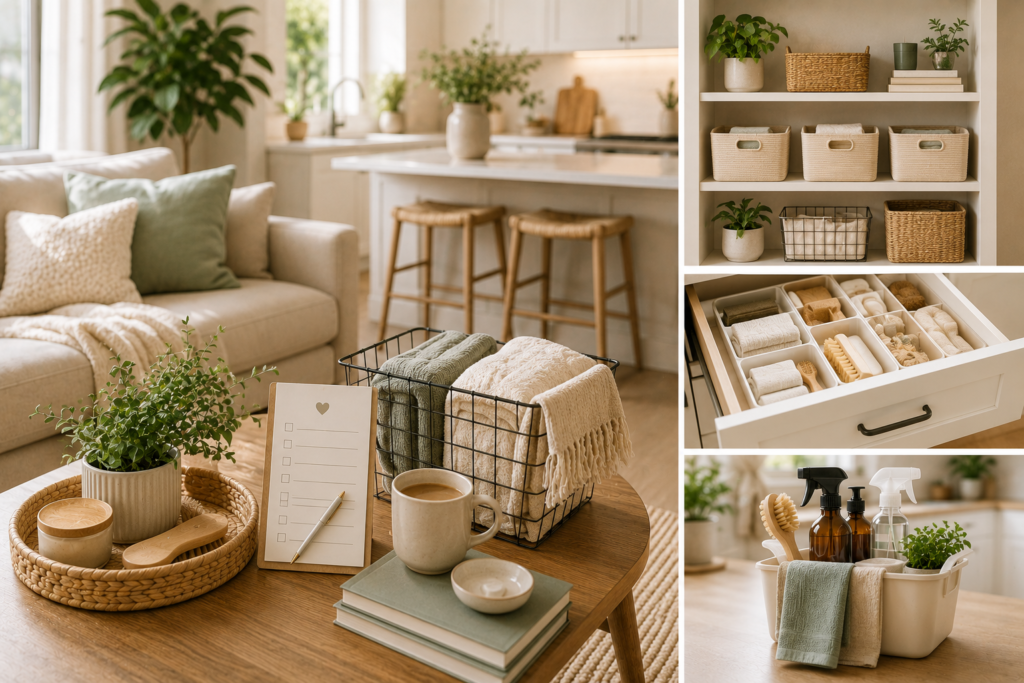
A clean and clutter-free home isn’t necessarily a home that gets cleaned for hours every day.
In fact, the easiest homes to maintain usually rely on simple systems and consistent habits rather than constant cleaning.
When everything has a place, clutter is easier to control. When small messes are handled quickly, they don’t have time to become overwhelming. And when your cleaning routine is simple, you’re much more likely to stick with it.
The goal isn’t to create a perfect home.
It’s to create a home that is easy to reset, easy to organize, and comfortable to live in.
In this guide, we’ll show you how to keep your home clean and clutter-free with 15 practical habits, including how to declutter, create storage zones, organize everyday items, control paperwork, maintain your kitchen and bathroom, and build a simple daily reset routine.
The Secret to a Clean and Clutter-Free Home
Before getting into the individual habits, remember this:
Everything needs a home.
If an item doesn’t have a designated place, it will eventually end up on a countertop, chair, table, floor, or another random surface.
A clutter-free home isn’t about owning nothing.
It’s about making it easy to put things away.
15 Habits That Keep Your Home Clean and Clutter-Free
| # | Habit | Main Benefit |
|---|---|---|
| 1 | Declutter before organizing | Creates usable space |
| 2 | Give everything a home | Prevents random clutter |
| 3 | Use the one-minute rule | Stops small tasks building up |
| 4 | Create a daily reset | Keeps mess under control |
| 5 | Keep countertops clear | Makes rooms feel cleaner |
| 6 | Follow a “one in, one out” rule | Controls new clutter |
| 7 | Deal with mail immediately | Prevents paper piles |
| 8 | Organize the entryway | Stops clutter at the door |
| 9 | Keep laundry moving | Prevents clothing piles |
| 10 | Clean while you cook | Reduces kitchen mess |
| 11 | Use baskets strategically | Controls loose items |
| 12 | Create clutter-free zones | Makes maintenance easier |
| 13 | Do regular mini-decluttering | Prevents accumulation |
| 14 | Use smart storage | Maximizes available space |
| 15 | Build a weekly reset | Keeps the whole home manageable |
1. Declutter Before You Organize
One of the biggest mistakes people make is trying to organize too many things.
Storage containers can make clutter look neater, but they don’t solve the underlying problem if you simply own too much.
Start with decluttering.
Choose one small area:
- One drawer
- One shelf
- One cabinet
- One closet section
Then remove everything.
Create four categories
Keep:
Things you regularly use or genuinely need.
Move:
Things that belong somewhere else.
Donate:
Useful things you no longer need.
Discard:
Broken, damaged, or unusable items.
The key question
Ask yourself:
“Would I choose to bring this into my home today?”
If the answer is no, consider whether you still need it.
2. Give Everything a Permanent Home
Once you’ve decluttered, assign a specific place to the things you keep.
For example:
- Keys → entryway
- Shoes → shoe storage
- Remote controls → living room basket
- Cleaning supplies → cleaning cabinet
- Chargers → charging station
- Mail → paperwork organizer
- Toys → toy storage
- Kitchen tools → designated drawers
The goal is to make putting something away almost automatic.
A useful test
If someone asked:
“Where does this belong?”
You should be able to answer immediately.
If you can’t, the item may need a better storage location.
3. Use the One-Minute Rule
If something takes less than a minute to complete, do it immediately.
Examples:
- Put a cup in the dishwasher.
- Hang up a jacket.
- Put shoes away.
- Throw away junk mail.
- Wipe a small spill.
- Return a remote control.
- Put a product back in the cabinet.
Why it works
Small tasks become overwhelming when dozens of them accumulate.
One minute now can prevent ten minutes later.
4. Create a Daily 10-Minute Reset
You don’t need to clean your entire house every night.
Instead, create a short reset routine.
Step-by-step
Minute 1–2: Pick up items that are out of place.
Minute 3–4: Clear kitchen countertops.
Minute 5: Load or wash dishes.
Minute 6: Put away clothing.
Minute 7: Straighten the living room.
Minute 8: Wipe a frequently used surface.
Minute 9: Check the entryway.
Minute 10: Return cleaning supplies and other items to their homes.
This small routine can make a noticeable difference the next morning.
5. Keep Countertops as Clear as Possible
A room can be completely clean but still look cluttered when every surface is covered with objects.
Countertops are particularly important because they are large visual areas.
In the kitchen
Try to keep only frequently used items visible.
For example:
- Coffee maker
- Toaster
- Fruit bowl
- Knife block
Store less frequently used appliances away when possible.
In the bathroom
Limit the number of products left around the sink.
Use drawers, cabinets, or organizers for everyday items.
The rule
If you don’t use it regularly, it doesn’t need premium countertop space.
6. Follow the “One In, One Out” Rule
One of the easiest ways to control clutter is to stop it from entering your home faster than you can remove it.
The one-in, one-out rule is simple:
When you bring in a new item, consider removing an old or similar item.
Examples
Buy a new:
T-shirt → donate an old T-shirt.
Mug → remove a mug you don’t use.
Kitchen gadget → review an existing gadget.
Pair of shoes → consider removing an old pair.
This is especially useful for categories that tend to grow quickly.
7. Deal With Mail and Paper Immediately
Paper clutter can accumulate surprisingly quickly.
Don’t let mail sit on the kitchen counter for weeks.
Create a simple system
Use three categories:
Action:
Bills, forms, or documents that require attention.
File:
Important documents that need to be kept.
Recycle/Shred:
Unnecessary paperwork.
Daily habit
Sort incoming mail as soon as practical.
Don’t create a permanent “I’ll deal with it later” pile.
8. Create an Organized Entryway
The entrance to your home is one of the first places clutter appears.
Shoes, bags, keys, jackets, and packages can quickly accumulate.
Give each item a home
Create dedicated storage for:
- Shoes
- Bags
- Keys
- Jackets
- Umbrellas
- Everyday accessories
A simple entryway setup
Step 1: Add a shoe rack or cabinet.
Step 2: Create hooks for frequently used bags or jackets.
Step 3: Add a small tray for keys.
Step 4: Keep only everyday items near the entrance.
Step 5: Remove unnecessary items regularly.
A well-organized entryway can make the entire home feel more organized.
9. Keep Laundry Moving
Laundry becomes clutter when it sits in piles.
The goal isn’t necessarily to do laundry every day.
The goal is to prevent clean and dirty clothes from becoming mixed together.
Create a simple system
Step 1: Put dirty clothes directly into the laundry basket.
Step 2: Wash when you have a suitable load.
Step 3: Dry promptly.
Step 4: Fold or hang clothes.
Step 5: Put everything away.
Avoid the “chair closet”
A chair covered with half-worn clothes may be convenient, but it quickly makes a bedroom look messy.
Give those clothes a proper place.
10. Clean While You Cook
The kitchen is one of the easiest areas to keep under control if you clean as you go.
Instead of waiting until the meal is finished, use cooking time efficiently.
Try this
While food is cooking:
- Put ingredients away.
- Rinse used utensils.
- Load the dishwasher.
- Wipe small spills.
- Clear your preparation area.
When dinner is ready, much of the cleanup is already done.
The result
You finish eating with a kitchen that requires less work.
11. Use Baskets to Control Loose Items
Baskets can be useful when used strategically.
They’re particularly helpful for items that don’t need to be individually organized.
Good basket locations
Living room:
Blankets, magazines, remotes.
Bedroom:
Accessories or frequently used items.
Bathroom:
Extra towels or suitable toiletries.
Entryway:
Bags and everyday accessories.
Kids’ area:
Toys.
Important
Don’t use baskets as a way to hide unlimited clutter.
A basket should be a storage system, not a place where everything disappears.
12. Create Clutter-Free Zones
You don’t need your entire home to be perfectly organized.
Start with a few important areas.
Examples
Kitchen counter zone
Keep it mostly clear.
Dining table
Keep it ready to use.
Living room seating
Keep sofas and chairs free of unnecessary objects.
Bedroom floor
Keep clothing and personal items off the floor.
Entryway
Keep pathways clear.
These small clutter-free zones can make your home feel significantly more organized.
13. Schedule Mini-Decluttering Sessions
Decluttering shouldn’t only happen when your home becomes overwhelming.
Schedule short sessions regularly.
Try 10 minutes once a week.
Choose one small area.
For example:
Week 1: Bathroom drawer
Week 2: Kitchen utensil drawer
Week 3: Entryway
Week 4: Bedroom closet
You don’t need to organize the entire house in one weekend.
The advantage
Small maintenance prevents large decluttering projects later.
14. Use Smart Storage to Maximize Space
The best storage solutions make things easier to access—not simply more hidden.
Useful storage ideas include:
- Drawer dividers
- Shelf risers
- Stackable bins
- Under-sink organizers
- Door-mounted organizers
- Storage baskets
- Clear containers
- Vertical organizers
But don’t buy storage blindly
Before buying anything, identify the problem.
Ask:
“What specifically am I trying to organize?”
Then choose a solution that addresses it.
15. Create a Weekly Home Reset
A weekly reset is your opportunity to bring the entire home back under control.
Choose a convenient day.
Weekly reset checklist
Put away clutter
Change bed linens
Vacuum floors
Mop hard floors
Clean bathrooms
Clean kitchen surfaces
Empty bins
Organize the entryway
Put away laundry
Review refrigerator contents
You can divide these tasks among household members to make the process faster.
Room-by-Room Clutter-Free Strategy
Kitchen
Focus on:
- Clear countertops
- Organized drawers
- Pantry categories
- Limited countertop appliances
- Daily dish routine
Best habit
Clean as you cook.
Living Room
Focus on:
- Clear surfaces
- Organized remotes
- Blanket storage
- Minimal decorative clutter
- Regular vacuuming
Best habit
Reset the room before bed.
Bedroom
Focus on:
- Clothes
- Nightstands
- Under-bed storage
- Closet organization
- Laundry
Best habit
Put clothes away instead of creating piles.
Bathroom
Focus on:
- Countertops
- Toiletries
- Towels
- Cleaning supplies
- Drawers
Best habit
Return products to their storage location after use.
Entryway
Focus on:
- Shoes
- Bags
- Keys
- Jackets
Best habit
Create a designated home for every item that enters the house.
How to Stop Clutter From Coming Back
Decluttering once isn’t enough.
The real challenge is keeping clutter from returning.
Use the “pause before buying” rule
Before purchasing something, ask:
- Do I actually need it?
- Where will I store it?
- Do I already own something similar?
- Will I use it regularly?
- Is it worth the space it will occupy?
If you can’t answer these questions, wait before buying.
The 5-Minute Evening Reset
If you don’t have time for a 10-minute routine, start with five minutes.
Minute 1
Clear the kitchen counter.
Minute 2
Put away items in the living room.
Minute 3
Put clothing where it belongs.
Minute 4
Clear the entryway.
Minute 5
Prepare the home for tomorrow.
Five minutes may not sound like much.
But five minutes every evening adds up to more than 30 minutes of maintenance each week.
How to Keep a Small Home Clutter-Free
Small spaces require more intentional organization because every item takes up valuable space.
Use vertical storage
Walls and doors can provide useful storage opportunities.
Choose multipurpose furniture
Look for furniture that provides storage as well as its primary function.
Avoid duplicates
You don’t need multiple versions of everything.
Keep surfaces clear
Open surfaces make small rooms feel larger.
Use hidden storage carefully
Storage baskets and cabinets can help keep everyday items organized without visually overwhelming the room.
Cleaning and Decluttering Are Different
It’s important to understand the difference.
Cleaning removes dirt, dust, stains, and grime.
Decluttering removes things you don’t need or puts misplaced things back where they belong.
You can have:
- A clean but cluttered home
- A tidy but dirty home
- A clean and organized home
The goal is to combine both.
A good sequence is:
Declutter → Organize → Clean → Maintain
Products That Can Help Keep Your Home Organized
You don’t need dozens of organizers.
Choose products that solve recurring problems.
Storage Baskets
Best for: Grouping loose everyday items.
Drawer Dividers
Best for: Keeping small items separated.
Shoe Organizer
Best for: Controlling entryway clutter.
Under-Bed Storage
Best for: Using otherwise wasted space.
Shelf Risers
Best for: Increasing cabinet capacity.
Label Maker
Best for: Shared storage systems and pantry organization.
Cleaning Caddy
Best for: Keeping cleaning supplies together.
Cord Organizer
Best for: Controlling chargers and cables.
The best organization products are those that make it easier to put things away and find them again.
Common Clutter-Causing Mistakes
Buying too many storage products
Storage doesn’t solve excess possessions.
Keeping things “just in case”
If you rarely use something, question whether it deserves permanent storage space.
Leaving items without a home
This creates recurring clutter.
Shopping without a plan
New purchases can quickly undo your organization efforts.
Using every surface as storage
Counters, tables, and chairs aren’t permanent storage areas.
Waiting for a major decluttering day
Small, regular sessions are easier to maintain.
Frequently Asked Questions
How do I keep my house clean and clutter-free every day?
Create simple habits: put things away after using them, clean small messes immediately, keep countertops clear, and perform a short daily reset.
What is the easiest way to declutter a home?
Start with one small area rather than the entire house. Remove items you don’t use, then organize what remains.
How often should I declutter?
A short 10-minute decluttering session once a week can help prevent clutter from accumulating. Larger areas such as closets can be reviewed seasonally.
How can I stop my home from getting messy?
Give everything a permanent home, avoid unnecessary purchases, and reset your main living areas every evening.
What should I do with things I rarely use?
Store them in a designated area if they are genuinely needed. If you no longer need them, consider donating, selling, recycling, or discarding them appropriately.
Are storage baskets worth buying?
Yes, when they solve a specific storage problem. Avoid buying organizers simply because they look attractive.
How do I keep a small home organized?
Prioritize frequently used items, use vertical and hidden storage, avoid duplicates, and keep major surfaces clear.
Final Verdict
Keeping your home clean and clutter-free isn’t about becoming obsessed with cleaning or organizing every drawer perfectly.
It’s about creating simple systems that make everyday life easier.
Give everything a home. Deal with small messes immediately. Keep your most visible surfaces clear. Declutter regularly. And spend just a few minutes each day resetting the spaces you use most.
The most important habit is consistency.
You don’t need to spend an entire weekend restoring order if you prevent clutter from building up in the first place.
Start with one room.
Then one surface.
Then one simple habit.
Over time, these small changes can transform your home into a space that feels cleaner, calmer, and much easier to maintain.