
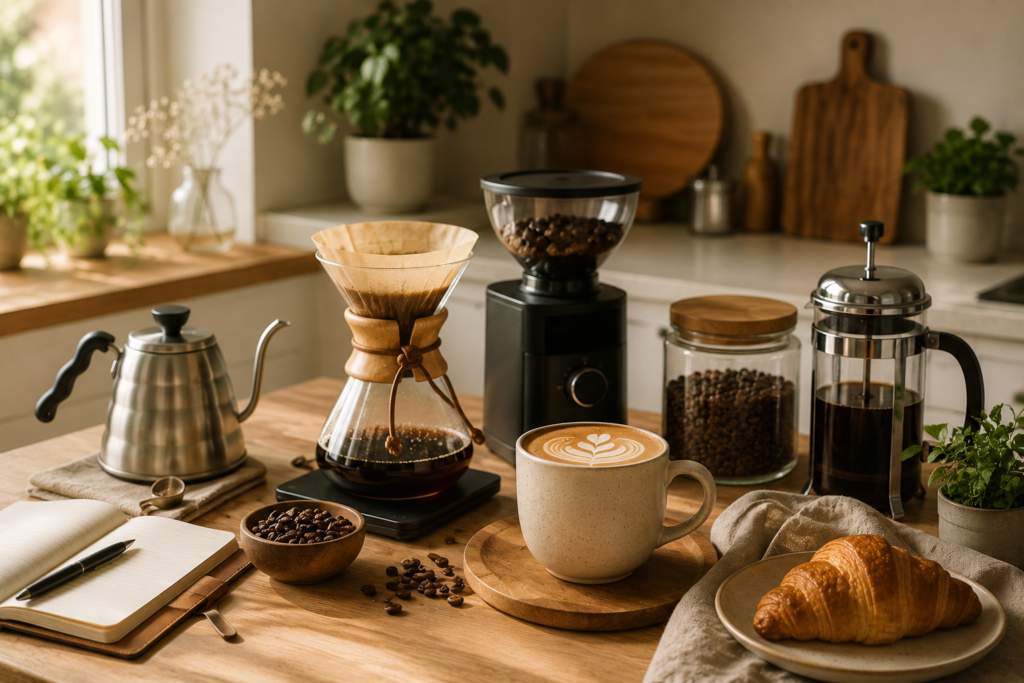
Making great coffee at home doesn’t necessarily require an expensive espresso machine or a countertop full of specialized equipment.
In many cases, better coffee comes down to a few simple fundamentals: using fresh beans, grinding them correctly, choosing good water, measuring your coffee, and using the right brewing method.
If your coffee tastes weak, bitter, sour, or simply doesn’t have the rich flavor you expect, there’s a good chance that one of these basics needs adjusting.
The good news?
You don’t have to change everything at once.
In this guide, we’ll walk through 10 practical ways to make better coffee at home, from choosing your beans to improving your brewing technique. We’ll also explain common mistakes and show you how to build a better coffee routine without unnecessary complexity.
The 10 Secrets to Better Coffee at Home
| Tip | Why It Matters | Difficulty |
|---|---|---|
| Use fresh coffee beans | Better aroma and flavor | Easy |
| Grind immediately before brewing | Preserves freshness | Easy |
| Choose the right grind size | Improves extraction | Easy |
| Measure coffee and water | Creates consistency | Easy |
| Use good-quality water | Improves flavor | Easy |
| Use the right water temperature | Controls extraction | Easy |
| Choose the right brewing method | Matches your taste | Easy |
| Keep equipment clean | Prevents stale flavors | Easy |
| Store coffee properly | Preserves freshness | Easy |
| Experiment and adjust | Helps you find your ideal cup | Easy |
1. Start With Fresh Coffee Beans
One of the easiest ways to improve your coffee is to start with better-quality beans.
Coffee is an agricultural product, and its flavor changes over time. Freshly roasted beans generally offer more aroma and flavor than coffee that has been sitting around for a long time.
What to look for
When buying coffee beans, look for:
- A clearly stated roast date
- Whole beans rather than pre-ground coffee
- A reputable roaster
- Beans appropriate for your preferred brewing method
Light, medium, or dark roast?
Your preferred roast depends on your taste.
Light roast: Often brighter, more acidic, and more fruit-forward.
Medium roast: Usually offers a balance of acidity, sweetness, and body.
Dark roast: Typically has stronger roasted, chocolatey, or smoky characteristics.
There isn’t one universally “best” roast.
The best coffee is the one you enjoy drinking.
2. Grind Your Coffee Just Before Brewing
If you’re currently buying pre-ground coffee, switching to freshly ground beans could make one of the biggest differences in your coffee routine.
Once coffee is ground, its increased surface area allows it to lose freshness more quickly.
The simple upgrade
Instead of:
Beans → store → grind later
Try:
Beans → grind → brew immediately
Why a grinder matters
A good grinder gives you control over the particle size, which directly affects how quickly water extracts flavor from the coffee.
For serious home brewing, a burr grinder is generally a better choice than a basic blade grinder because it produces a more consistent grind.
3. Use the Correct Grind Size
Grind size is one of the most important variables in coffee brewing.
Different brewing methods require different grind sizes.
| Brewing Method | Typical Grind |
| French Press | Coarse |
| Cold Brew | Coarse |
| Drip Coffee Maker | Medium |
| Pour Over | Medium to Medium-Fine |
| AeroPress | Medium to Fine |
| Espresso | Fine |
| Moka Pot | Fine to Medium-Fine |
These are starting points rather than strict rules.
Your exact grind may need adjustment depending on your coffee beans, grinder, recipe, and brewing equipment.
How grind size affects flavor
Too coarse: Coffee may taste weak, sour, or underdeveloped.
Too fine: Coffee may taste bitter, harsh, or overly strong.
The goal is to find the grind size that produces the flavor balance you enjoy.
4. Measure Your Coffee and Water
One of the biggest mistakes home brewers make is measuring coffee by eye.
One day you might use two spoonfuls.
The next day you might use three.
The result?
Your coffee tastes different every morning.
The better approach
Use a consistent coffee-to-water ratio.
A useful starting point is around:
1 gram of coffee for every 15–18 grams of water.
For example:
20 g coffee + 300 g water
This gives you a starting ratio of approximately 1:15.
You can then adjust according to your taste.
Why a coffee scale helps
A small digital scale allows you to measure both coffee and water accurately.
It doesn’t need to be expensive to be useful.
Consistency is the real advantage.
5. Use Good-Quality Water
Coffee is mostly water.
That means the water you use can have a surprisingly large impact on the final cup.
If your tap water has a strong chlorine taste, unpleasant odor, or very high mineral content, it may affect your coffee.
Try this
Use:
- Filtered water
- Good-quality bottled water
- Water specifically formulated for coffee, if appropriate
Don’t overlook this
If your coffee suddenly tastes different after moving to a new home or changing your water source, the water may be part of the reason.
6. Pay Attention to Water Temperature
Water that is too hot or too cool can affect extraction.
For many brewing methods, a useful starting range is approximately:
90–96°C (194–205°F)
You don’t necessarily need to obsess over the exact temperature.
The important thing is to avoid using boiling water directly in situations where your brewing method recommends a lower temperature.
A simple approach
If you don’t have a thermometer:
- Bring the water to a boil.
- Let it sit briefly.
- Begin brewing.
For more precision, use a kettle with temperature control.
7. Choose the Right Brewing Method
Different coffee brewing methods produce very different results.
Choosing the right method can be more important than buying the most expensive equipment.
Drip Coffee Maker
Best for: Convenience and multiple cups.
A good automatic coffee maker can produce consistently good coffee with minimal effort.
Ideal for:
- Busy mornings
- Families
- Office-style coffee
- Brewing several cups
French Press
Best for: Full-bodied coffee.
French press brewing uses immersion, allowing coffee grounds to remain in contact with the water for several minutes.
Basic method
- Add coarse-ground coffee.
- Add hot water.
- Stir gently.
- Let it steep.
- Slowly press the filter.
- Pour immediately.
Pour Over
Best for: Clean, detailed flavors.
Pour-over brewing gives you more control over:
- Water flow
- Brewing time
- Coffee-to-water ratio
- Extraction
Basic method
- Place the filter in the dripper.
- Rinse the filter if appropriate.
- Add ground coffee.
- Add a small amount of water to wet the grounds.
- Wait briefly.
- Slowly pour the remaining water.
- Allow the coffee to drain.
- Serve immediately.
Pour over is particularly appealing if you enjoy experimenting with coffee flavor.
Espresso Machine
Best for: Espresso-based drinks.
An espresso machine allows you to make drinks such as:
- Espresso
- Americano
- Cappuccino
- Latte
- Flat white
- Macchiato
However, espresso requires more precision than many other brewing methods.
You’ll need to pay attention to:
- Grind size
- Dose
- Distribution
- Tamping
- Extraction time
- Water temperature
If you’re new to specialty coffee, it’s often easier to master a simpler brewing method before moving into espresso.
8. Keep Your Coffee Equipment Clean
Even excellent coffee beans won’t taste great if your equipment is dirty.
Coffee oils can build up inside grinders, brewing equipment, carafes, and espresso machines.
Simple cleaning routine
Every use:
- Empty used coffee grounds.
- Rinse removable components.
- Clean the brewing area.
Regularly:
- Clean your grinder according to its instructions.
- Wash the coffee carafe.
- Clean reusable filters.
- Descale your coffee maker when recommended.
Why this matters
Old coffee residue can introduce stale, bitter, or rancid flavors into otherwise good coffee.
A clean machine is one of the easiest ways to protect the flavor of your beans.
9. Store Your Coffee Properly
Even great beans can lose quality if they’re stored incorrectly.
Avoid storing coffee:
- In direct sunlight
- Near heat
- In a humid environment
- In an open container
- Next to strong-smelling foods
Better storage
Keep coffee beans in a sealed, airtight container in a cool, dry location.
You don’t need a complicated storage system.
The main goal is to protect the beans from excessive exposure to air, moisture, heat, and light.
What about the refrigerator?
For everyday storage, the refrigerator usually isn’t necessary and can expose coffee to moisture and food odors when the container is opened.
10. Adjust One Variable at a Time
This is one of the most useful lessons for improving your coffee.
If your coffee doesn’t taste right, don’t change everything simultaneously.
Instead, change one variable.
Coffee tastes too sour?
Try:
- A slightly finer grind
- Longer brewing time
- Slightly hotter water
Coffee tastes too bitter?
Try:
- A slightly coarser grind
- Shorter brewing time
- Slightly cooler water
Coffee tastes weak?
Try:
- More coffee
- Less water
- A finer grind, depending on the brewing method
Coffee tastes too strong?
Try:
- Less coffee
- More water
- A coarser grind, depending on the brewing method
Make small adjustments and taste the result.
This turns coffee brewing into a simple process of experimentation rather than guesswork.
A Simple Better-Coffee Routine
If you want consistently better coffee without making your morning complicated, try this routine.
Step 1: Choose fresh beans
Buy beans from a reliable roaster and check the roast date.
Step 2: Store them correctly
Keep them sealed in a cool, dry place.
Step 3: Grind immediately before brewing
Use the grind size appropriate for your brewing method.
Step 4: Measure your coffee
Start with approximately 1 gram of coffee for every 15–18 grams of water.
Step 5: Use good water
Filtered water can make a noticeable difference if your tap water isn’t ideal.
Step 6: Control the brewing temperature
Use an appropriate temperature for your brewing method.
Step 7: Brew consistently
Try to repeat the same process each morning.
Step 8: Taste and adjust
Change one variable at a time until you find your preferred recipe.
What Equipment Do You Actually Need?
You don’t need a professional coffee bar to make excellent coffee at home.
Beginner setup
A simple setup could include:
- Quality coffee beans
- Burr grinder
- Digital scale
- Brewing device
- Kettle
- Airtight storage container
For pour-over coffee
Consider adding:
- Pour-over dripper
- Paper filters
- Gooseneck kettle
- Coffee scale
For espresso
Consider:
- Espresso machine
- Espresso grinder
- Tamper
- Scale
- Knock box
- Milk pitcher if making milk drinks
The most important thing is to buy equipment that matches the way you actually want to make coffee.
Common Coffee-Making Mistakes
Using old beans
Freshness matters.
Grinding too early
Ground coffee loses freshness faster than whole beans.
Guessing measurements
Small changes in the coffee-to-water ratio can change the flavor significantly.
Using the wrong grind
Different brewing methods require different grind sizes.
Ignoring water quality
Poor-tasting water can produce poor-tasting coffee.
Leaving coffee sitting on heat
Extended heating can negatively affect flavor.
Not cleaning your equipment
Old coffee oils and residue can contaminate the flavor of fresh coffee.
How to Make Coffee Taste Better Without Buying Expensive Equipment
You don’t need to spend hundreds of dollars to improve your coffee.
Start with these upgrades:
Upgrade #1: Buy fresher beans
This may have the biggest impact.
Upgrade #2: Grind immediately before brewing
A basic quality burr grinder can make a significant difference.
Upgrade #3: Measure your coffee
A simple digital scale improves consistency.
Upgrade #4: Improve your water
Try filtered water if your tap water isn’t ideal.
Upgrade #5: Clean your equipment
It’s free—and often overlooked.
These five changes can improve your coffee routine before you invest in expensive equipment.
How to Find Your Perfect Coffee Recipe
There isn’t one perfect coffee recipe for everyone.
Your ideal cup depends on:
- Bean origin
- Roast level
- Grind size
- Water
- Brewing method
- Coffee-to-water ratio
- Water temperature
- Brewing time
- Personal taste
Instead of trying to copy someone else’s recipe exactly, use their recipe as a starting point.
Then experiment.
Try a simple coffee experiment
Brew the same beans three times.
Cup 1: Use your normal recipe.
Cup 2: Grind slightly finer.
Cup 3: Grind slightly coarser.
Taste all three side by side.
You’ll quickly begin to notice how grind size changes the flavor.
Frequently Asked Questions
What is the easiest way to make better coffee at home?
Start with fresh whole beans, grind them immediately before brewing, use good-quality water, measure your coffee, and keep your equipment clean.
Does grinding coffee fresh really make a difference?
Yes. Grinding immediately before brewing helps preserve the aroma and flavor of the coffee compared with storing coffee after it has already been ground.
What is the best coffee-to-water ratio?
A useful starting point is around 1:15 to 1:18, meaning one gram of coffee for approximately 15–18 grams of water. Adjust it according to your taste and brewing method.
What grind size should I use?
It depends on the brewing method. French press generally uses a coarse grind, drip coffee a medium grind, pour-over a medium to medium-fine grind, and espresso a fine grind.
Why does my coffee taste bitter?
Over-extraction can contribute to bitterness. Try a slightly coarser grind, shorter brewing time, or lower water temperature.
Why does my coffee taste sour?
Under-extraction can produce sour or sharp flavors. Try a slightly finer grind, longer brewing time, or higher water temperature.
Is filtered water better for coffee?
It can be, particularly if your tap water has strong flavors or characteristics that negatively affect the coffee. Water quality plays an important role because coffee is mostly water.
Do I need an expensive coffee machine?
No. Excellent coffee can be made with relatively simple equipment. Fresh beans, a good grinder, appropriate water, accurate measurements, and good technique are often more important than the price of the machine.
Final Verdict
Making better coffee at home isn’t about owning the most expensive coffee equipment.
It’s about getting the fundamentals right.
Start with fresh beans. Grind them immediately before brewing. Use the appropriate grind size, measure your coffee and water, choose good-quality water, and keep your equipment clean.
Once those basics are under control, you can experiment with different beans, brewing methods, ratios, and temperatures to discover exactly what you like.
And if you’re ready to upgrade your coffee setup, don’t buy everything at once.
Start with the equipment that will make the biggest difference to your current routine—usually a good grinder, a reliable brewing method, and a simple digital scale.
The goal isn’t to make coffee complicated.
The goal is to make your everyday cup taste better.