
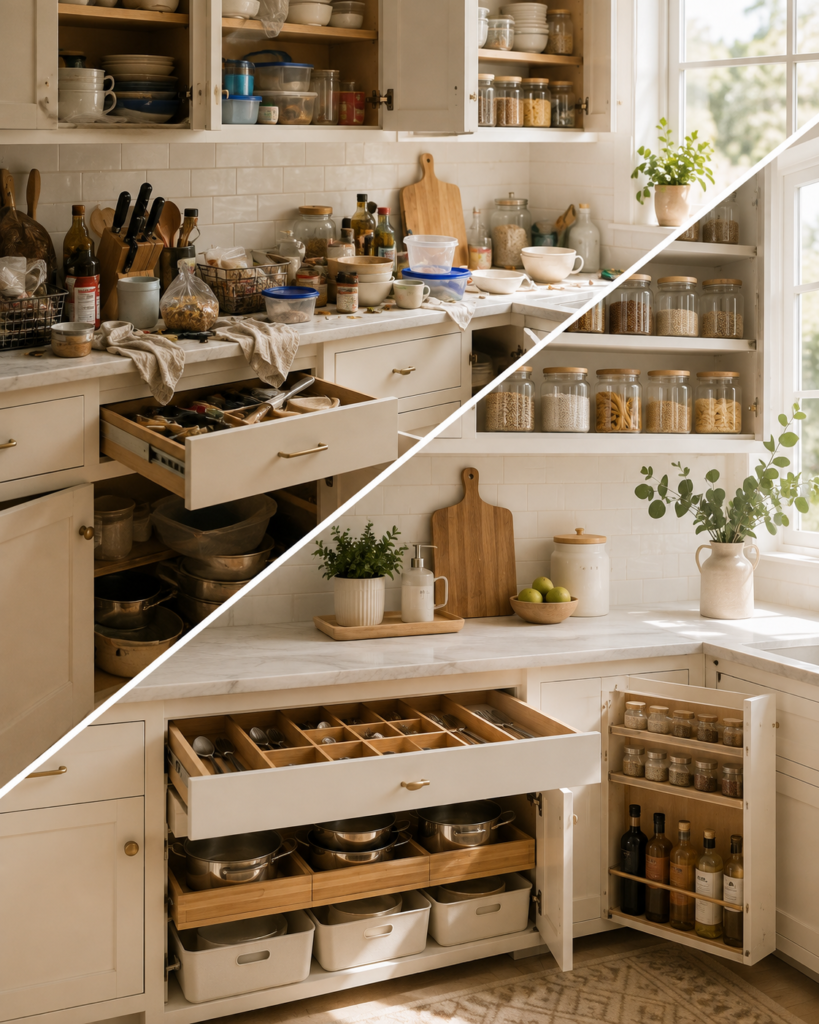
A well-organized kitchen should make cooking, cleaning, and everyday routines easier—not more complicated.
Yet even a kitchen that looks tidy can have organization problems. You may have beautiful storage containers, neatly arranged cabinets, and plenty of shelves, but if the system doesn’t match how you actually use the kitchen, clutter will eventually return.
The good news is that most kitchen organization mistakes are easy to fix.
From storing frequently used items in inconvenient places to buying too many organizers, small changes can make a surprisingly big difference.
In this guide, we’ll cover 10 common kitchen organization mistakes to avoid, along with practical steps for creating a kitchen that’s easier to use and maintain.
1. Organizing Before Decluttering
One of the biggest kitchen organization mistakes is trying to organize everything before deciding what you actually need.
If your cabinets are filled with duplicate utensils, expired food, and appliances you rarely use, adding storage containers won’t solve the problem.
It simply gives your clutter a nicer home.
How to fix it
Before organizing a cabinet or drawer:
- Remove everything.
- Group similar items together.
- Check expiration dates where appropriate.
- Identify duplicates.
- Remove broken or unused items.
- Return only what you actually need.
Declutter first, organize second.
This simple rule can save you time, money, and valuable storage space.
2. Keeping Everyday Items in Hard-to-Reach Places
Your kitchen should be organized around your daily routine.
If you use your coffee maker every morning, storing it at the back of a cabinet doesn’t make much sense.
The same applies to:
- Plates
- Glasses
- Cooking utensils
- Cutting boards
- Knives
- Everyday spices
- Frequently used appliances
A better approach
Keep the items you use most often:
- At eye level
- Near your main workspace
- In easy-to-open drawers
- On accessible shelves
Store occasional-use items higher up or farther away.
The rule
The more frequently you use something, the easier it should be to reach.
3. Overcrowding Your Kitchen Counters
Kitchen countertops are valuable workspace.
When they’re covered with appliances, containers, paperwork, and miscellaneous items, the kitchen can feel smaller and become harder to clean.
Common countertop clutter includes:
- Toasters
- Blenders
- Coffee makers
- Air fryers
- Food packaging
- Utensils
- Decorative items
This doesn’t mean everything must be hidden.
If you use your coffee maker every morning, leaving it accessible can make sense.
But appliances you use only occasionally can usually be stored away.
Try this
Remove everything from your countertop.
Then return only the items you use regularly.
You’ll probably be surprised by how much space you recover.
4. Buying Storage Containers Before Measuring
Storage containers can be useful, but buying them before measuring your cabinets and drawers is a common mistake.
A container that looks perfect online may be too tall, too wide, or awkwardly shaped for your actual storage space.
Before buying organizers, measure:
- Cabinet width
- Cabinet depth
- Shelf height
- Drawer dimensions
- Available vertical space
Then choose storage products that fit those measurements.
Pro tip
Don’t organize based on the product.
Choose the storage solution based on the problem you’re trying to solve.
5. Using One Large Cabinet for Everything
Large cabinets can quickly become black holes.
If baking supplies, cookware, food containers, appliances, and random kitchen items are all mixed together, finding something becomes unnecessarily difficult.
Instead, create zones.
For example:
Baking zone:
Flour, sugar, baking tools, measuring cups
Cooking zone:
Pots, pans, cooking utensils
Breakfast zone:
Coffee, tea, mugs, cereal
Food storage zone:
Containers, lids, wraps
Cleaning zone:
Sponges, dishwashing supplies, cleaning products
Grouping items by function makes your kitchen easier to navigate.
6. Ignoring Vertical Space
Many kitchens have valuable vertical space that goes unused.
You may have several inches of empty space above plates, cups, or food containers.
Instead of letting that space go to waste, consider:
- Shelf risers
- Stackable organizers
- Cabinet-door organizers
- Wall-mounted shelves
- Hooks
- Hanging rails
But don’t overdo it
Vertical storage is useful only when it makes things easier to access.
If you have to remove five items to reach one plate, you’ve created another organization problem.
7. Stacking Items Without a System
Stacking can save space, but random stacking makes items difficult to access.
This is especially common with:
- Pots
- Pans
- Food containers
- Baking dishes
- Plates
- Cutting boards
Better solutions
For pots and pans, consider:
- Pan organizers
- Vertical dividers
- Pull-out racks
For food containers:
- Stack containers by size
- Keep lids together
- Use a dedicated drawer or shelf
For baking trays:
- Store them vertically with dividers
The goal is to make every item easy to remove without disturbing everything around it.
8. Creating a Drawer Full of “Everything”
The kitchen junk drawer can quickly become one of the most disorganized areas in the home.
You may find:
- Batteries
- Rubber bands
- Takeout menus
- Random screws
- Pens
- Chargers
- Kitchen tools
- Receipts
Instead of treating the drawer as a place for anything you don’t know where to put, give it a purpose.
How to fix it
- Empty the drawer.
- Throw away obvious rubbish.
- Remove items that belong elsewhere.
- Group similar items.
- Add small dividers if necessary.
- Keep only useful items.
If you have multiple categories, consider creating separate storage areas.
9. Storing Food Without Checking Expiration Dates
An organized pantry isn’t truly organized if expired or forgotten food is hiding behind newer products.
This can lead to:
- Wasted food
- Duplicate purchases
- Unnecessary clutter
- Difficulty finding ingredients
Try the FIFO method
FIFO stands for First In, First Out.
Place older products toward the front and newer products behind them.
This encourages you to use older food first.
Pantry reset
Every few weeks:
- Check expiration dates.
- Move older items forward.
- Group similar foods.
- Remove products you won’t use.
- Wipe shelves if necessary.
This keeps your pantry both organized and functional.
10. Making Your Organization System Too Complicated
One of the most overlooked kitchen organization mistakes is creating a system that’s difficult to maintain.
You might create beautifully labeled containers, multiple categories, and complicated storage zones—but if putting something away takes too much effort, the system won’t last.
A good organization system should be:
- Simple
- Accessible
- Logical
- Easy to maintain
- Suitable for everyone using the kitchen
If you have to think about where something belongs every time you put it away, simplify the system.
The best kitchen organization system is the one you can maintain every day.
How to Fix Your Kitchen Organization Step by Step
If your kitchen currently feels cluttered, don’t try to fix everything at once.
Use this simple process:
Step 1: Choose One Zone
Start with one cabinet, drawer, pantry shelf, or countertop.
Step 2: Empty It
Remove everything so you can see what you’re working with.
Step 3: Declutter
Remove duplicates, broken items, expired products, and things you don’t use.
Step 4: Group Similar Items
Create functional categories.
Step 5: Decide Where Each Category Belongs
Consider where you use each item.
Step 6: Add Storage Only If Needed
Measure first.
Step 7: Put Everything Back
Keep frequently used items accessible.
Step 8: Test the System
Use the kitchen normally for several days.
If something feels inconvenient, change it.
How to Organize Your Kitchen Around Your Workflow
A beautiful kitchen isn’t necessarily an efficient kitchen.
Think about the activities you perform regularly.
Food preparation
Keep knives, cutting boards, mixing bowls, and frequently used ingredients close to your main preparation area.
Cooking
Keep pots, pans, cooking utensils, oils, and everyday seasonings near the stove where practical.
Cleaning
Store dishwashing supplies close to the sink.
Breakfast and coffee
Keep coffee, mugs, breakfast foods, and frequently used appliances together if that suits your routine.
The goal is to reduce unnecessary movement around the kitchen.
Small Kitchen Organization Tips
If you have a small kitchen, every inch matters.
Try these strategies:
Use vertical storage
Take advantage of walls and cabinet height.
Choose multi-purpose items
Avoid owning multiple tools that perform essentially the same function.
Use drawer dividers
Small compartments prevent drawers from becoming cluttered.
Store appliances strategically
Keep everyday appliances accessible and occasional-use appliances elsewhere.
Use cabinet doors
The inside of cabinet doors can provide useful storage for lightweight items when the hardware and cabinet are suitable.
Keep countertops clear
A clear work surface can make a small kitchen feel significantly more spacious.
Kitchen Organization Mistakes to Avoid When Buying Products
When shopping for kitchen organization products, avoid buying something simply because it looks attractive.
Before purchasing, ask:
What problem will this solve?
Then consider:
- Will it fit my space?
- Will it make items easier to access?
- Is it easy to clean?
- Will I actually use it?
- Does it create more steps?
- Is it durable enough?
- Could I solve the problem without buying anything?
This approach prevents your kitchen from becoming filled with unnecessary organizers.
A Simple Weekly Kitchen Reset
You don’t need to reorganize your entire kitchen every week.
A short reset is enough:
Every day
- Clear countertops
- Return items to their places
- Wash or load dishes
- Wipe frequently used surfaces
Once a week
- Check the refrigerator
- Review the pantry
- Clean one drawer or shelf
- Remove unnecessary items
Once a month
- Review rarely used items
- Check expiration dates
- Reorganize problem areas
- Adjust storage if your routine has changed
Small maintenance sessions are much easier than waiting until the kitchen becomes completely disorganized.
Frequently Asked Questions
What is the biggest kitchen organization mistake?
Trying to organize without decluttering first is one of the most common mistakes. If you have too many unnecessary items, storage solutions alone won’t solve the problem.
How do I organize a kitchen with limited storage?
Start by removing unused items, then use vertical space, drawer dividers, stackable storage, and functional zones. Keep frequently used items within easy reach.
Should kitchen counters be completely clear?
Not necessarily. Frequently used appliances can remain accessible. The goal is to eliminate unnecessary clutter while preserving convenience.
Are kitchen organizers worth buying?
Yes, when they solve a specific storage problem. Measure your space and determine what you need before purchasing organizers.
How often should I reorganize my kitchen?
A small weekly reset and monthly review can prevent major problems. A full reorganization is usually only necessary when your needs or kitchen setup change.
How can I keep my kitchen organized?
Give everything a designated home, avoid overfilling storage, return items after use, and regularly remove things you no longer need.
Final Verdict
A well-organized kitchen isn’t about having the most storage products or the most perfectly arranged cabinets.
It’s about creating a system that makes everyday tasks easier.
Start by decluttering, then organize items according to how you actually use your kitchen. Keep frequently used items accessible, take advantage of vertical space, and avoid filling your countertops and cabinets with unnecessary items.
Most importantly, keep your system simple.
The Bottom Line
The best kitchen organization system is practical, easy to access, and simple enough to maintain every day.
Avoid these common mistakes, and your kitchen can become cleaner, more efficient, and much easier to enjoy.