
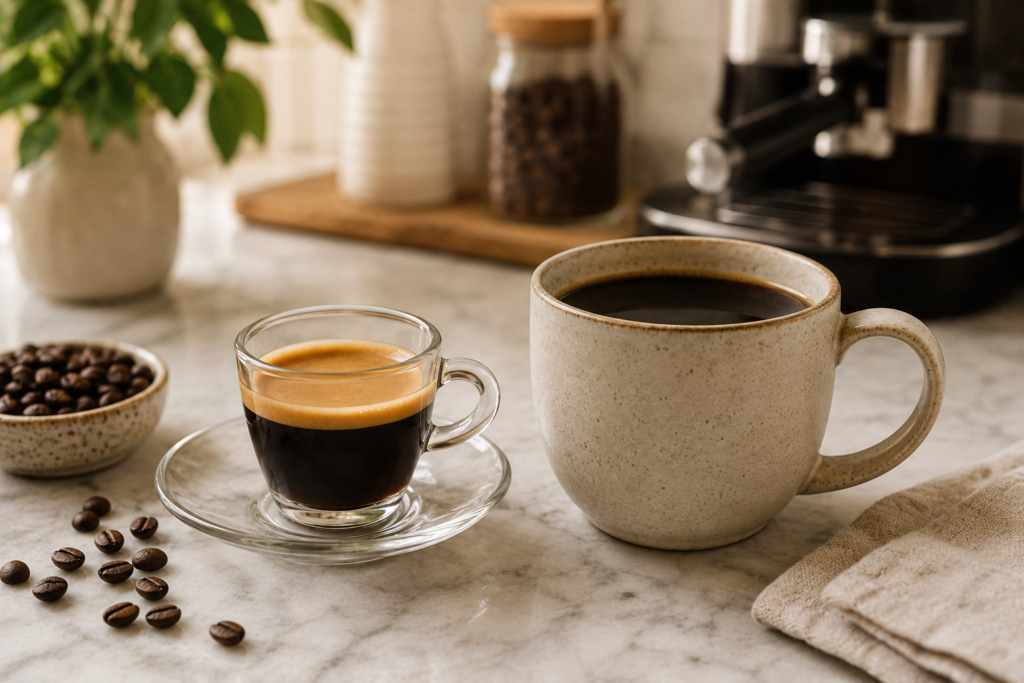
If you enjoy coffee, you have probably wondered: What is the difference between espresso and regular coffee?
The simplest answer is that espresso is a brewing method, not a different type of coffee bean. Espresso is made by forcing hot water through finely ground coffee at high pressure, producing a small, concentrated shot with an intense flavor and creamy layer called crema.
Regular coffee, often called drip coffee or filter coffee, is usually brewed by allowing hot water to pass more slowly through medium-ground coffee and a filter. This creates a larger, lighter-bodied drink.
Both can be made from the same coffee beans. The biggest differences come from grind size, brewing method, water-to-coffee ratio, serving size, flavor, and preparation time.
So, which is better? That depends on how you like your coffee.
Espresso vs. Coffee at a Glance
| Feature | Espresso | Drip Coffee |
|---|---|---|
| Brewing method | High-pressure extraction | Filter brewing |
| Grind size | Very fine | Medium |
| Typical serving | 1–2 oz | 8–12 oz |
| Flavor | Strong, concentrated | Smoother, lighter |
| Brewing time | Around 20–30 seconds | Around 3–6 minutes |
| Crema | Yes | No |
| Caffeine per serving | Concentrated | More total caffeine in a larger serving |
| Common uses | Espresso, cappuccino, latte, americano | Black coffee, iced coffee, flavored coffee |
Important: Espresso is not necessarily higher in caffeine than a full cup of coffee. Espresso contains more caffeine per ounce, but a typical serving of drip coffee contains more total caffeine because the serving is much larger.
What Is Espresso?
Espresso is a concentrated coffee beverage made by pushing hot water through finely ground coffee under pressure.
A traditional espresso shot is small but intense, with a rich aroma, concentrated flavor, and a layer of crema on top.
How espresso is made
The basic process looks like this:
- Grind the coffee beans finely.
- Measure the coffee into a portafilter.
- Distribute and tamp the grounds evenly.
- Lock the portafilter into the espresso machine.
- Start the extraction.
- Hot water passes through the coffee under pressure.
- Collect the espresso in a small cup.
- Serve immediately or use it as the base for another drink.
The entire extraction can take only a few dozen seconds, but achieving consistently good espresso requires properly balanced grind size, dose, water temperature, pressure, and extraction time.
What Is Regular Coffee?
When people say “regular coffee,” they usually mean coffee brewed using a method such as drip, pour-over, or automatic filter brewing.
Instead of forcing water through the coffee quickly under pressure, these methods allow water to extract flavor from the grounds over a longer period.
How drip coffee is made
- Grind the beans to a medium grind.
- Place a filter in the coffee maker.
- Add the coffee grounds.
- Add water.
- Allow the brewing cycle to run.
- Collect the brewed coffee in a carafe or cup.
- Serve hot or over ice.
Because more water is used, regular coffee produces a much larger drink than a traditional espresso shot.
The Main Differences Between Espresso and Coffee
1. Brewing Method
The biggest difference is how the coffee is extracted.
Espresso uses pressure to force water through a compact bed of finely ground coffee.
Drip coffee relies primarily on gravity, with water flowing through a bed of ground coffee and a filter.
This difference in extraction creates much of the contrast in texture, intensity, and flavor.
2. Grind Size
Grind size is another major difference.
Espresso requires a fine grind because water needs to extract the coffee quickly.
Drip coffee generally uses a medium grind, allowing water to flow through the grounds over several minutes.
Using the wrong grind can significantly affect the final cup.
If espresso is ground too coarse
Water can pass through too quickly, resulting in a weak or under-extracted shot.
If espresso is ground too fine
The water may struggle to pass through the coffee, potentially producing a slow, bitter, or over-extracted shot.
If drip coffee is ground incorrectly
A grind that is too fine can slow the flow and create excessive extraction, while a grind that is too coarse may produce weak, under-extracted coffee.
3. Flavor and Strength
Espresso generally tastes stronger, more concentrated, and more intense than drip coffee.
Because the drink contains much less water relative to the amount of coffee used, its flavors are concentrated into a small volume.
Drip coffee usually has a lighter body and allows you to enjoy a larger range of aromas and subtle flavor notes.
However, “stronger taste” does not automatically mean “more caffeine.”
4. Caffeine Content
This is one of the most common points of confusion.
Espresso contains more caffeine per ounce, but a standard serving is much smaller.
For example:
- A single espresso shot is typically around 1 ounce.
- A regular cup of coffee is often 8–12 ounces.
- A larger serving of drip coffee can therefore contain more total caffeine than one espresso shot.
The exact amount varies depending on the coffee beans, roast, brewing method, serving size, and recipe.
What about a double espresso?
A double espresso contains roughly twice the coffee dose of a single shot, so it can contain significantly more caffeine than a single espresso.
This is why you should compare total serving caffeine, rather than simply assuming espresso always has more.
5. Serving Size
Espresso is designed to be consumed in a small serving.
A traditional single shot is approximately 1 ounce, although modern espresso recipes can vary considerably.
Drip coffee is usually served in a much larger cup.
A typical home coffee mug may contain 8–12 ounces or more.
This difference is one reason espresso tastes so much more concentrated.
6. Texture and Crema
A well-prepared espresso has a distinctive texture that you usually won’t find in drip coffee.
The extraction can produce crema, a golden-brown layer that forms on top of the espresso.
Crema contributes to the visual appearance, aroma, and texture of the drink.
Drip coffee does not normally develop the same crema because it is brewed using a different extraction process.
7. Brewing Time
Espresso can be brewed very quickly.
Once the machine is ready and the coffee is prepared, the extraction itself can take roughly 20–30 seconds, depending on the recipe.
Drip coffee usually takes several minutes because water needs to pass gradually through the grounds.
However, espresso requires more preparation. You may need to grind the beans, dose the coffee, distribute the grounds, tamp them, and clean the equipment afterward.
Espresso vs. Coffee: Which Is Stronger?
This depends on what you mean by stronger.
If you mean more concentrated flavor, espresso wins.
If you mean more caffeine per ounce, espresso usually wins.
If you mean more total caffeine in a typical serving, a large cup of drip coffee can contain more.
So the statement “espresso is stronger than coffee” is only partially correct.
A better way to describe espresso is that it is more concentrated.
Can You Use the Same Coffee Beans for Espresso and Regular Coffee?
Yes.
You do not need special “espresso beans” to make espresso.
The term espresso roast is commonly used by coffee companies to describe beans that they recommend for espresso, but espresso can technically be made from many different coffee beans and roast profiles.
The important difference is the grind and brewing method.
For example, you could use the same coffee beans to make:
- Espresso
- Drip coffee
- Pour-over
- French press
- Cold brew
You would simply adjust the grind size and brewing recipe for the chosen method.
Espresso-Based Drinks vs. Regular Coffee Drinks
One major advantage of espresso is its versatility.
Espresso forms the foundation of many popular coffee drinks.
Popular espresso drinks
Espresso:
A concentrated shot served on its own.
Americano:
Espresso combined with hot water.
Latte:
Espresso combined with steamed milk and a relatively small layer of foam.
Cappuccino:
Espresso with steamed milk and a more substantial layer of milk foam.
Macchiato:
Espresso traditionally marked with a small amount of milk or foam.
Mocha:
Espresso combined with chocolate and milk.
Regular brewed coffee can also be customized with milk, cream, sugar, syrups, or other ingredients, but it does not provide the same concentrated espresso base.
Which One Should You Choose?
The right choice depends on your coffee preferences and daily routine.
Choose Espresso If You:
- Prefer intense, concentrated flavors
- Enjoy cappuccinos and lattes
- Want a small, powerful coffee drink
- Like experimenting with coffee recipes
- Enjoy café-style drinks
- Want to make milk-based espresso beverages at home
Choose Drip Coffee If You:
- Prefer a larger cup
- Like a smoother, less concentrated drink
- Want coffee that you can sip over a longer period
- Prefer simple preparation
- Regularly make coffee for several people
- Enjoy tasting subtle flavors in brewed coffee
How to Choose the Right Coffee Setup
If you’re deciding whether to invest in an espresso machine or a regular coffee maker, consider these factors.
Step 1: Decide What You Drink Most
Think about your normal order at a coffee shop.
If you usually order lattes, cappuccinos, Americanos, or espresso, an espresso machine may make more sense.
If you usually order black coffee or a large brewed coffee, a drip coffee maker may be more practical.
Step 2: Consider Convenience
A drip coffee maker is generally straightforward:
Add coffee → add water → press brew.
Espresso usually requires more hands-on preparation:
Grind → dose → distribute → tamp → extract → clean.
Some automatic espresso machines can simplify the process, but they still require more maintenance than a basic drip machine.
Step 3: Consider Your Budget
You can make excellent coffee with relatively affordable equipment.
However, espresso equipment can become more expensive because you may need:
- An espresso machine
- An espresso grinder
- A scale
- A tamper
- A distribution tool
- Cleaning supplies
A drip setup can be considerably simpler.
Step 4: Think About Maintenance
Espresso machines need regular cleaning to maintain performance and coffee quality.
You may need to:
- Clean the portafilter.
- Rinse the group head.
- Empty and clean the drip tray.
- Clean the steam wand after using milk.
- Backflush the machine when required.
- Descale the machine according to the manufacturer’s instructions.
Drip coffee makers also need cleaning and descaling, but the routine is generally simpler.
Common Mistakes When Comparing Espresso and Coffee
Mistake 1: Thinking Espresso Is a Different Bean
Espresso is primarily a brewing method. The same coffee beans can be used for other brewing methods.
Mistake 2: Assuming Espresso Always Has More Caffeine
Espresso has more caffeine by volume, but a full cup of drip coffee can contain more total caffeine.
Mistake 3: Using the Same Grind for Both
Espresso generally requires a much finer grind than drip coffee.
Mistake 4: Thinking Darker Roast Means More Caffeine
Roast level affects flavor and other characteristics, but it does not provide a simple “darker roast = more caffeine” rule.
Mistake 5: Buying an Expensive Espresso Machine Without a Good Grinder
For espresso, grinder quality and grind consistency can have a major effect on extraction.
Frequently Asked Questions
Is espresso stronger than coffee?
Espresso is more concentrated and generally has more caffeine per ounce. However, a typical cup of drip coffee can contain more total caffeine because it is much larger.
Is espresso healthier than regular coffee?
Neither is automatically healthier. Both can fit into a balanced diet, and the nutritional differences often depend on what you add to the drink.
Can I make espresso without an espresso machine?
Traditional espresso requires specialized pressure and equipment. Some alternative brewing devices can produce concentrated coffee, but they should not necessarily be considered true espresso.
Can I use espresso beans in a coffee maker?
Yes. You can brew beans marketed for espresso using a drip coffee maker. The flavor may differ from what the roaster intended, but the beans themselves can be brewed using different methods.
Is an Americano stronger than regular coffee?
An Americano is made by adding water to espresso. Its flavor can be more espresso-forward, but its overall strength depends on the number of shots and amount of water used.
Which has more caffeine: espresso or coffee?
Espresso generally has more caffeine per ounce, while a normal serving of drip coffee often contains more total caffeine because it is much larger.
Final Verdict
So, espresso vs. coffee—which one is better?
There is no universal winner.
Espresso is the better choice if you love concentrated flavor, café-style drinks, and hands-on brewing. It is also the foundation for drinks such as lattes, cappuccinos, and Americanos.
Drip coffee is the better choice if you want a larger, smoother drink with simple preparation and an easy everyday routine.
The most important thing to remember is that espresso and regular coffee can come from the same beans. What really changes the experience is how those beans are ground, extracted, and served.
If you’re building a home coffee setup, start with the type of coffee you actually enjoy drinking. The right machine is the one that makes it easier to prepare your favorite cup every day.
The Bottom Line
Choose espresso for intensity and versatility. Choose drip coffee for simplicity and a larger, slower-sipping cup.