
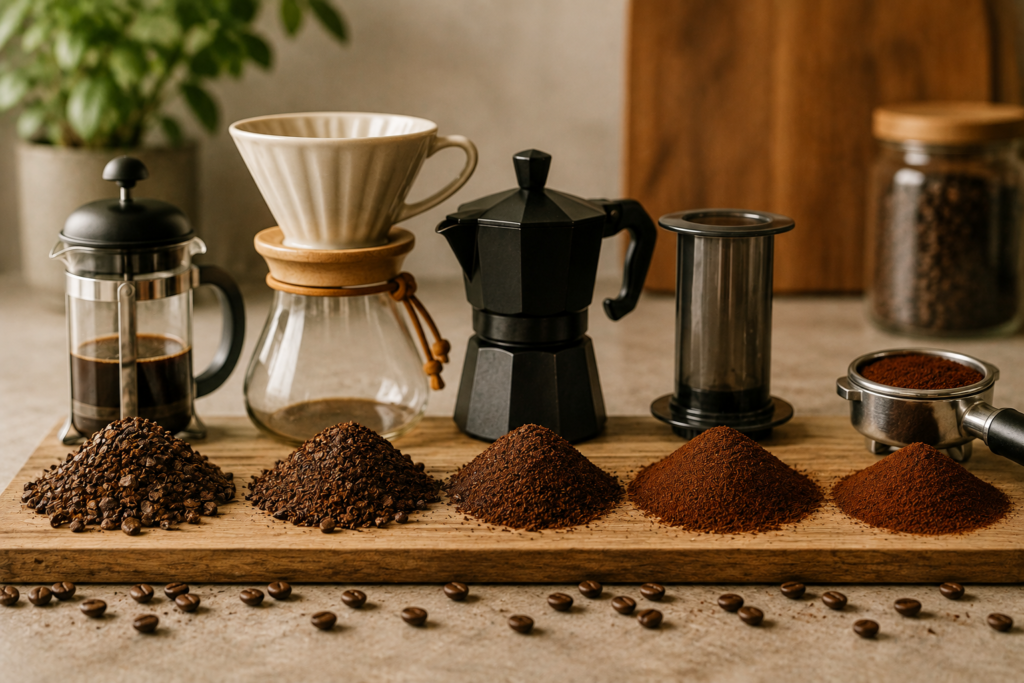
If your coffee tastes too bitter, sour, weak, or watery, the problem may not be your coffee beans. It could be your coffee grind size.
Grind size is one of the most important factors in coffee brewing because it controls how quickly water extracts flavor from the coffee grounds. A small change in grind size can completely change the taste of your final cup.
The basic rule is simple:
Finer grounds extract faster. Coarser grounds extract more slowly.
However, choosing the right grind is not simply about making coffee “stronger.” The goal is to find the right balance between grind size, brewing method, water temperature, brewing time, and coffee-to-water ratio.
In this guide, we’ll explain exactly why coffee grind size matters, how to choose the right grind for each brewing method, and how to adjust your grinder when your coffee doesn’t taste right.
Coffee Grind Size at a Glance
| Brewing Method | Recommended Grind | Typical Result |
|---|---|---|
| Turkish coffee | Extra fine | Very concentrated |
| Espresso | Fine | Rich and intense |
| Moka pot | Fine to medium-fine | Strong and concentrated |
| AeroPress | Fine to medium | Balanced and versatile |
| Pour-over | Medium-fine to medium | Clean and bright |
| Drip coffee | Medium | Smooth and balanced |
| Chemex | Medium-coarse | Clean and lighter-bodied |
| French press | Coarse | Full-bodied and smooth |
| Cold brew | Coarse | Smooth and mellow |
These recommendations are starting points rather than strict rules. Your specific grinder, coffee beans, recipe, and brewing equipment may require adjustments.
What Is Coffee Grind Size?
Coffee grind size refers to how finely or coarsely coffee beans are ground before brewing.
When whole coffee beans are ground, they are broken into smaller particles.
A fine grind creates small particles with a large amount of surface area exposed to water.
A coarse grind creates larger particles with less exposed surface area.
This difference affects how quickly water interacts with the coffee.
Fine grind
Think of fine coffee grounds as having a texture similar to table salt or, depending on the brewing method, even finer.
Medium grind
Medium grounds have a texture similar to regular granulated sugar or sand.
Coarse grind
Coarse grounds have noticeably larger particles and may resemble coarse sea salt.
The exact appearance varies depending on the grinder, so visual comparison should only be used as a general guide.
Why Does Grind Size Affect Coffee Flavor?
The main reason grind size matters is extraction.
During brewing, water dissolves compounds from the coffee grounds. Different compounds are extracted at different stages, contributing to the coffee’s aroma, acidity, sweetness, bitterness, body, and overall flavor.
Grind size influences how quickly this happens.
Finer grind = faster extraction
Because fine grounds have more surface area exposed to water, extraction can happen more quickly.
Coarser grind = slower extraction
Larger particles expose less surface area, so water generally needs more time to extract flavor.
This is why changing grind size is one of the easiest ways to adjust your coffee recipe.
What Happens When Coffee Is Ground Too Fine?
If your coffee is ground too fine for your brewing method, the water may extract too much from the grounds.
This can result in:
- Bitter flavors
- Harshness
- Dry or astringent sensations
- Overly intense flavors
- Slow water flow
- A muddy or unpleasant cup
This is especially noticeable with methods that depend on controlled water flow, such as espresso and pour-over brewing.
Example
If your espresso machine produces a very slow shot and the coffee tastes bitter and dry, your grind may be too fine.
A small adjustment toward a coarser grind may improve the extraction.
What Happens When Coffee Is Ground Too Coarse?
A grind that is too coarse can allow water to pass through the coffee too quickly.
The result may be under-extraction.
Common signs include:
- Sour flavors
- Sharp acidity
- Weak body
- Watery texture
- Flat or unfinished flavor
If your coffee tastes thin and sour even though you’re using good beans, your grind may be too coarse.
The Golden Rule: Match Grind Size to Brewing Time
One of the easiest ways to understand grind size is to think about contact time.
Fast brewing methods generally need finer grounds.
Slow brewing methods generally need coarser grounds.
For example:
Espresso → Fine grind → Short brewing time
Drip coffee → Medium grind → Moderate brewing time
French press → Coarse grind → Longer brewing time
This isn’t an absolute rule, but it provides an excellent starting point.
How to Choose the Right Coffee Grind Size
Step 1: Identify Your Brewing Method
Start by determining how you make your coffee.
Are you using:
- An espresso machine?
- A drip coffee maker?
- A pour-over brewer?
- A French press?
- An AeroPress?
- A moka pot?
- A cold brew system?
Your brewing method determines your starting grind size.
Step 2: Start With the Recommended Grind
Use the manufacturer’s recommended setting when available.
If you’re using a burr grinder with numbered settings, remember that grinder numbers are not universal.
For example, setting 10 on one grinder may produce a completely different grind from setting 10 on another.
Instead of copying a number from another grinder, focus on the resulting particle size and the taste of the coffee.
Step 3: Brew Your Coffee
Keep your other variables as consistent as possible.
For example, maintain the same:
- Coffee dose
- Water amount
- Water temperature
- Brewing method
- Brewing time
This makes it easier to understand what changed when you adjust the grind.
Step 4: Taste the Coffee
Don’t rely only on brewing time.
Taste the coffee and ask:
Does it taste sour, weak, bitter, dry, or balanced?
Your taste is one of the best indicators of whether you need to adjust the grind.
Step 5: Make Small Adjustments
Avoid changing the grind dramatically.
Instead, make a small adjustment and brew again.
If the coffee tastes sour or weak:
Try grinding slightly finer.
If the coffee tastes bitter or dry:
Try grinding slightly coarser.
This process is often called dialing in your coffee.
Grind Size for Different Brewing Methods
Espresso
Recommended starting point: Fine
Espresso requires a fine grind because water passes through the coffee under pressure and the extraction happens quickly.
If your espresso flows too quickly and tastes sour or weak, try grinding finer.
If it flows too slowly and tastes bitter or dry, try grinding coarser.
Espresso is particularly sensitive to small grind adjustments, so a good burr grinder is an important part of a quality espresso setup.
Drip Coffee
Recommended starting point: Medium
Automatic drip coffee makers typically work well with a medium grind.
A grind that is too fine can restrict water flow and produce bitter or over-extracted coffee.
A grind that is too coarse can result in weak, under-extracted coffee.
If your coffee maker produces a cup that tastes balanced and pleasant, there may be no reason to change the grind.
Pour-Over Coffee
Recommended starting point: Medium-fine to medium
Pour-over brewing gives you significant control over extraction, which makes grind size especially important.
If the water drains too quickly, you may need a finer grind.
If the water drains too slowly, you may need a coarser grind.
However, don’t adjust grind size based on flow time alone. Taste should always be part of the decision.
French Press
Recommended starting point: Coarse
French press coffee is typically brewed for several minutes, so a coarse grind helps prevent excessive extraction and reduces the amount of fine sediment that passes through the filter.
A grind that is too fine can make French press coffee muddy, bitter, or overly heavy.
Moka Pot
Recommended starting point: Fine to medium-fine
A moka pot produces concentrated coffee using pressure generated by heated water.
A grind that is too fine can restrict water flow and potentially produce poor results.
Start slightly finer than a typical drip grind, but avoid treating moka pot coffee exactly like espresso.
AeroPress
Recommended starting point: Fine to medium
One of the advantages of the AeroPress is its flexibility.
You can experiment with different grind sizes depending on your recipe and brewing time.
A finer grind can work well with shorter brewing recipes, while a coarser grind can be useful for longer steeping methods.
Cold Brew
Recommended starting point: Coarse
Cold brew usually involves a long extraction period, often many hours.
A coarse grind is a practical starting point because it helps with filtration and can make the finished drink smoother and easier to separate from the grounds.
Burr Grinder vs. Blade Grinder
Your grinder can be just as important as the grind size itself.
Burr Grinder
A burr grinder crushes coffee beans between two grinding surfaces.
A quality burr grinder generally produces a more consistent particle size.
This consistency makes it easier to control extraction and repeat your favorite recipes.
Advantages
- More consistent grind
- Better control
- Easier adjustments
- Better suited to espresso
- More repeatable brewing
Blade Grinder
A blade grinder chops coffee beans using a spinning blade.
It can be affordable and convenient, but it generally produces a less consistent mixture of particle sizes.
You may end up with a combination of very fine particles and large pieces.
Advantages
- Affordable
- Compact
- Simple to use
Disadvantages
- Less consistent grind
- Limited control
- More difficult to reproduce the same result
For someone who regularly brews specialty coffee, a burr grinder is usually the better long-term investment.
Why Grind Consistency Matters
Imagine brewing coffee with a mixture of dust-sized particles and large chunks.
The smallest particles can extract very quickly, while the larger particles extract much more slowly.
This makes it difficult to achieve balanced extraction.
A more consistent grind gives you better control over the brewing process.
That’s one reason premium coffee grinders focus heavily on grind consistency.
How to Dial In Your Coffee
Dialing in means adjusting your recipe until the coffee tastes balanced.
Follow this simple process:
1. Start with a consistent recipe
Use the same coffee dose and water amount.
2. Choose your starting grind
Use the recommended grind for your brewing method.
3. Brew the coffee
Follow your normal recipe.
4. Taste it
Pay attention to acidity, bitterness, sweetness, body, and aftertaste.
5. Identify the problem
If the coffee tastes sour and thin, consider grinding finer.
If it tastes bitter and dry, consider grinding coarser.
6. Adjust one variable
Change the grind size first instead of changing everything at once.
7. Brew again
Compare the new cup with the previous one.
8. Repeat until balanced
Small adjustments can make surprisingly large differences.
Coffee Grind Size Troubleshooting Guide
| Problem | Possible Cause | First Adjustment |
| Sour and weak | Under-extraction | Grind finer |
| Bitter and harsh | Over-extraction | Grind coarser |
| Watery | Too little extraction | Grind finer |
| Dry or astringent | Too much extraction | Grind coarser |
| Brewing too quickly | Grind too coarse | Grind finer |
| Brewing too slowly | Grind too fine | Grind coarser |
| Muddy French press | Grounds too fine | Grind coarser |
| Espresso tastes weak | Extraction too fast | Grind finer |
Remember that grind size is only one variable. Coffee dose, water temperature, brewing time, water quality, and the beans themselves can also affect the result.
Does Freshly Ground Coffee Really Matter?
Yes.
Coffee begins losing some of its aromatic compounds after grinding because the increased surface area accelerates exposure to oxygen.
Grinding your beans shortly before brewing can help preserve more of the coffee’s aroma and flavor.
For the best results:
- Buy whole beans when possible.
- Store them in an airtight container.
- Keep them away from excessive heat, light, and moisture.
- Grind immediately before brewing.
- Avoid buying more coffee than you can reasonably use while it is fresh.
A good grinder can therefore be one of the most valuable upgrades for a home coffee setup.
How to Store Coffee Beans
Even the perfect grind cannot rescue poorly stored coffee.
Follow these simple storage practices:
Keep coffee airtight
Use an airtight container to reduce exposure to oxygen.
Keep it dry
Moisture can negatively affect coffee quality.
Avoid excessive heat
Store coffee somewhere cool and stable.
Protect it from light
A dark storage location is preferable to direct sunlight.
Don’t store coffee in the grinder
Keeping beans inside a grinder for extended periods can expose them to air and affect freshness.
Common Coffee Grinding Mistakes
Using One Grind Size for Every Brewing Method
Espresso and French press require very different grind sizes.
Trying to use one setting for everything usually produces inconsistent results.
Changing Too Many Variables at Once
If you change grind size, dose, water temperature, and brewing time simultaneously, you won’t know what actually improved the coffee.
Change one major variable at a time.
Ignoring Taste
A recipe can tell you where to start, but your taste tells you whether the coffee is actually working.
Grinding Too Much Coffee in Advance
Freshly grinding immediately before brewing can help preserve aroma and flavor.
Choosing a Grinder Based Only on Price
The cheapest grinder isn’t always the best value.
For regular coffee brewing, prioritize consistent grinding, useful adjustment settings, durability, and ease of cleaning.
Frequently Asked Questions
What is the best grind size for coffee?
There is no single best grind size. It depends on your brewing method. Espresso generally requires a fine grind, drip coffee a medium grind, and French press a coarse grind.
Does finer coffee make stronger coffee?
Not necessarily. A finer grind generally increases the rate of extraction. It can make coffee taste more intense, but if it causes over-extraction, the result may simply taste bitter or harsh.
Why does my coffee taste bitter?
Over-extraction is one possible cause. Try grinding slightly coarser and keep the other brewing variables consistent.
Why does my coffee taste sour?
Sour or sharp coffee can be a sign of under-extraction. Try grinding slightly finer and brew again.
What grind size is best for espresso?
A fine grind is the standard starting point for espresso. However, the exact setting depends on the grinder, coffee beans, dose, and espresso recipe.
What grind size is best for French press?
A coarse grind is a common starting point for French press coffee. It can help reduce excessive extraction and make filtering easier.
Is a burr grinder better than a blade grinder?
For most coffee enthusiasts, yes. Burr grinders generally provide more consistent particles and greater control, which makes it easier to produce repeatable results.
Final Verdict:
Does Coffee Grind Size Really Matter?
Absolutely.
Coffee grind size is one of the most important variables in brewing because it directly affects how quickly water extracts flavor from your coffee grounds.
The good news is that you don’t need to become a coffee expert overnight.
Start with the recommended grind for your brewing method, keep your recipe consistent, taste the result, and make small adjustments.
Remember the basic rule:
Too sour or weak? Try a slightly finer grind.
Too bitter or dry? Try a slightly coarser grind.
Once you understand how grind size affects extraction, making better coffee at home becomes much easier.
And if you’re upgrading your coffee setup, don’t focus only on the coffee maker. A quality burr grinder can be one of the most worthwhile investments you make.
The Bottom Line
The right grind size helps your coffee taste balanced, flavorful, and consistent. Match the grind to your brewing method, adjust based on taste, and change one variable at a time.